Why Is Padel the Fastest Growing Sport in the World?
Padel courts are appearing everywhere. New clubs open monthly across Europe, Latin America, and the Middle East. Something unusual is happening, and it is moving fast.
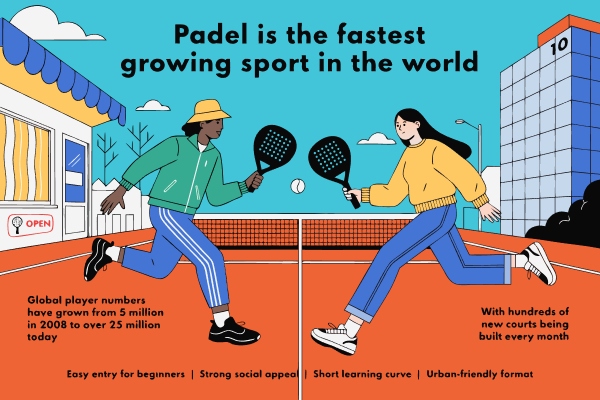
Padel is the fastest growing sport in the world because it combines easy entry for beginners, strong social appeal, and a short learning curve — all in a format that fits urban environments. Global player numbers have grown from 5 million in 2008 to over 25 million today, with hundreds of new courts built every month.
I work in padel equipment manufacturing at PDK. I watch this growth from a very direct position. Every year, the order volume increases. Every year, new markets ask about our products for the first time. Countries that had no padel presence three years ago are now building multi-court clubs. I want to look at why this is happening — not just from a sports perspective, but from a business and cultural perspective too.
How Has the World Padel Tour1 Changed the Sport’s Global Reach?
Most sports grow slowly through grassroots participation. Padel grew differently. A professional tour gave it legitimacy and visibility at a critical moment in the sport’s development.
The World Padel Tour (WPT), launched in 2005, gave padel a professional competitive structure that broadcast the sport to global audiences. This created aspirational role models for new players, attracted sponsor investment2, and pushed equipment brands to develop higher-performance products — all of which accelerated the sport’s mainstream growth.
I remember the shift clearly. Before WPT events were streamed widely, padel was a sport most people outside Spain and Argentina had never heard of. Then the matches started appearing on YouTube and social platforms. Players watched professionals hit spectacular shots in glass-walled courts. The visual spectacle of padel — the glass walls, the tight exchanges, the lob-and-smash dynamics — looks extremely good on camera. That is not a small thing. Sports that look good on screen grow faster in the social media era.
What Did the World Padel Tour Do for the Equipment Industry?
The WPT did not just grow the player base. It transformed the equipment market3. Professional competition creates pressure on manufacturers to improve products. It also creates a direct marketing channel where products are seen by millions of viewers.
| WPT Impact Area | Effect on the Sport | Effect on the Equipment Industry |
|---|---|---|
| Professional visibility | Created role models and aspirational players | Players wanted tour-level equipment |
| Media coverage | Global audiences discovered padel | Brand awareness grew outside Spain and Argentina |
| Sponsor investment | Increased financial resources in the sport | Equipment brands received investment to scale |
| Rule and court standardization | Consistent experience across all courts | Manufacturers had clear production standards to meet |
| Talent development | More professional players emerged worldwide | Demand for performance equipment at club level increased |
| Social media highlights | Viral shots reached non-padel audiences | Entry-level players entered the market in large numbers |
The standardization point is one that matters directly to manufacturers like PDK. When the WPT established consistent court dimensions and equipment regulations, it gave manufacturers a stable target to build toward. Before clear standards, there was more variation in product specifications across markets. After standardization, a racket built to WPT specifications could be sold in Spain, Sweden, Dubai, or Mexico without modification. This opened global distribution in a way that was not previously practical.
The other effect I want to highlight is the entry-level player effect. When new players discover padel through watching professional matches, they do not always buy professional-level equipment immediately. But they buy something. The WPT created a large wave of entry-level buyers who then progressed through equipment tiers as their game developed. That progression cycle — beginner racket, intermediate racket, performance racket — is the engine of the padel equipment retail market. The WPT started that cycle for millions of players.
What Social and Fitness Benefits Are Driving Padel’s Popularity?
Many sports are good for fitness. Fewer sports are genuinely fun to play from the very first session. Padel sits in an unusual position. It delivers fitness benefits while also being immediately enjoyable for players of almost any level.
Padel offers measurable cardiovascular fitness benefits, full-body movement, and low injury risk4 due to the smaller court and underarm serve. At the same time, its doubles format5 and glass-wall gameplay create a naturally social environment that encourages regular play and long-term participation.
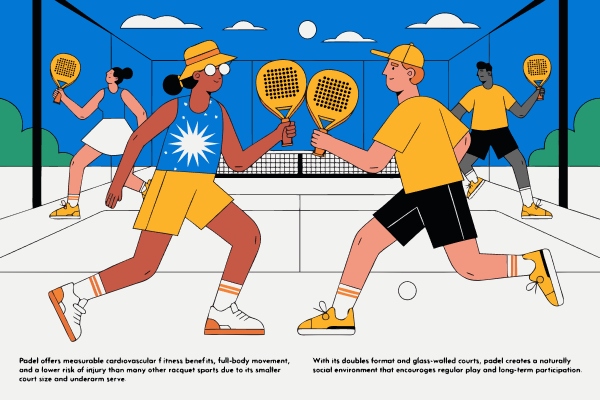
I have spoken with club operators in Spain and the Netherlands. They both said the same thing about why members renew their subscriptions: they come for fitness but stay for the social element6. Padel is almost always played as doubles. You need three other people to play a proper game. That requirement forces social connection. It builds a community around the court. Members make friends. They book regular games. They bring new people to try the sport. The club becomes a social anchor, not just a fitness facility.
How Does Padel Compare to Other Racket Sports on Key Participation Factors?
One reason padel grows faster than other racket sports is that it removes several barriers that keep people away from tennis, squash, and badminton at the beginner stage.
| Factor | Padel | Tennis | Squash | Badminton |
|---|---|---|---|---|
| Learning curve | Low — playable in first session | High — technique-heavy | Medium | Medium |
| Physical demand | Medium — accessible for all fitness levels | High | Very high | Medium |
| Injury risk | Low — small court, underarm serve | Medium — shoulder, elbow | Medium–High | Low–Medium |
| Social format | Always doubles — naturally social | Can be singles, less social | Usually singles | Can be either |
| Court availability | Growing fast, especially in Europe | Established but expensive | Declining | Stable |
| Equipment cost | Medium — racket and balls affordable | High — racket, strings, court fees | Medium | Low |
| Spectator appeal | High — glass walls, visible from all sides | Medium | Low — hard to watch | Low |
The learning curve difference is the most important factor for new player recruitment. A person who tries padel for the first time and manages to keep a rally going — even a short one — feels success. That feeling of early competence is a powerful driver of continued participation. Tennis often fails on this point. New tennis players spend their first sessions struggling to get the ball over the net. Padel gives them a rally experience from session one because the walls keep the ball in play.
Injury risk also matters as the sport grows into older demographics. Many padel players are between 35 and 55 years old. This age group is active but injury-conscious. The underarm serve removes the shoulder stress of a tennis serve. The smaller court reduces the running load on knees and hips. For a generation that wants to stay active but cannot sustain the physical demands of high-impact sports, padel is a direct answer.
Why Are Investors Paying Attention to the Padel Industry Right Now?
Sports investment follows growth signals. When a sport grows fast enough, in enough markets, capital follows. Padel has reached that threshold. Investment is moving into courts, clubs, media rights, and equipment brands7 at a pace that was not visible five years ago.
Investors are entering the padel industry8 because the sport shows three clear signals: rapid user growth across multiple high-income markets, underbuilt infrastructure relative to demand, and a proven monetization model through court rental, club membership, and equipment sales. These signals indicate a long-term market, not a short-term trend.
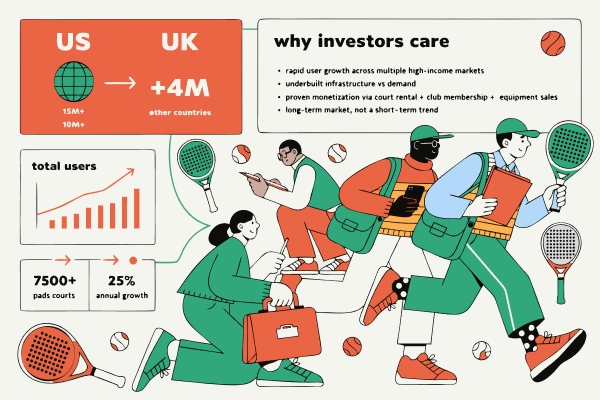
I track this closely because it directly affects how the equipment market develops. When a new padel club opens, it needs courts. Courts need equipment. Clubs build pro shops. Pro shops need rackets, balls, bags, and accessories. Investment in club infrastructure drives demand for equipment at every level. Each new club built is a recurring revenue stream for manufacturers and distributors who supply it.
What Are the Key Investment Areas in Padel Right Now?
Investment in padel is not concentrated in one area. It is moving across the full ecosystem of the sport. Here is where capital is going and what it signals for the industry.
| Investment Area | What Is Happening | What It Signals |
|---|---|---|
| Court construction | Multi-court clubs opening across Europe, MENA, Americas | Long-term infrastructure demand |
| Club chains and franchises | Groups like Padel Nuestro and Five Padel expanding rapidly | Consolidated buying power for equipment |
| Media and streaming rights | Premier Padel backed by FIFA and top sponsors | Sport moving toward mainstream broadcast |
| Equipment brands | Private equity investment in racket and apparel brands | Product market growing, brand wars beginning |
| Technology (booking, coaching apps) | Digital platforms for court booking and player development | Data-driven participation growth |
| Real estate integration | Padel courts added to hotels, residential developments, gyms | Sport becoming a lifestyle feature |
The real estate integration9 point is one that surprised me when I first started seeing it clearly. Luxury residential developments in Spain and the UAE are now including padel courts as a selling feature. The same way a swimming pool or gym adds value to a property, a padel court now does the same. This embeds the sport into daily life in a way that casual sports facilities do not. Residents of those buildings play regularly because the court is steps away. Their children grow up playing padel. That is a generational participation effect that is very hard to reverse.
For distributors and equipment suppliers, the investor attention on padel means two things. First, the market will continue to grow. Investor capital accelerates growth, builds new demand, and raises the visibility of the sport. Second, the market will become more competitive. As more brands enter and more manufacturers scale up, product differentiation and private-label options become more important. Distributors who build their own brand identity now — before the market saturates — will be in a much stronger position than those who remain dependent on third-party brands. This is exactly why at PDK we are seeing more distributors ask about OEM and private-label options. They see what is coming and they want their own product line ready before the window narrows.
Conclusion
Padel grows because it is easy to start, social by design, and financially attractive to investors. The WPT gave it global visibility, the fitness and social benefits keep players coming back, and capital is now accelerating everything.
-
Explore how the WPT has revolutionized padel and its global reach, influencing players and fans alike. ↩
-
Find out how sponsor investment fuels growth and innovation in sports, particularly in padel. ↩
-
Discover how the WPT has transformed the padel equipment market and influenced product development. ↩
-
Find out which sports, including padel, are safe for older adults, minimizing injury while promoting fitness. ↩
-
Learn about the advantages of the doubles format in sports, which promotes teamwork and social interaction. ↩
-
Discover how the social aspect of sports like padel fosters community and encourages regular participation among players. ↩
-
Understand the competitive landscape and growth of equipment brands in padel. ↩
-
Explore insights on the padel industry’s growth and investment opportunities. ↩
-
Find out how luxury developments are embedding padel into lifestyle choices. ↩