Can You Get Quality OEM Custom Padel Rackets Made in China?
Many distributors want custom padel rackets but worry about quality. They have heard bad stories. They are not sure if China can deliver what they need at the standard their customers expect.
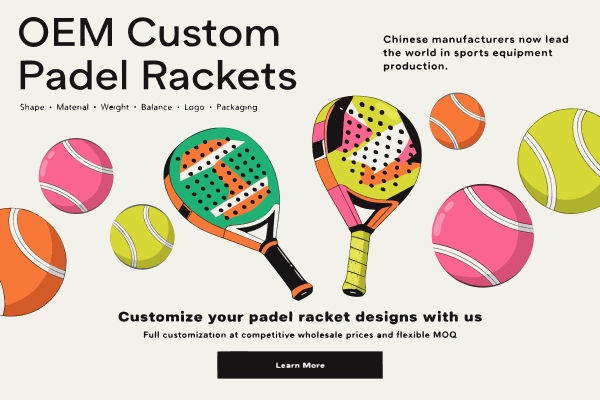
Yes, you can get high-quality OEM custom padel rackets made in China. Chinese manufacturers now lead the world in sports equipment production, offering full customization including shape, material, weight, balance, logo, and packaging — all at competitive wholesale prices with flexible MOQ options.
I run PDK — Padel Keeper — a China-based manufacturer focused entirely on padel equipment. I talk to distributors from Spain, Italy, the Netherlands, and the Middle East every week. The same questions come up every time. Can your factory match our quality standards? Can you handle our volume? Can we put our brand on the product? The answer to all three is yes. But I want to go deeper than just saying yes. I want to show you exactly why China leads in this space, what custom options are available, and how quality is controlled at every step.
Why Does China Lead the World in Sports Equipment Production?
Some distributors still think China means low quality. That idea is outdated. The global sports equipment industry has shifted. Most premium brands you know source from China, even if they do not say so publicly.
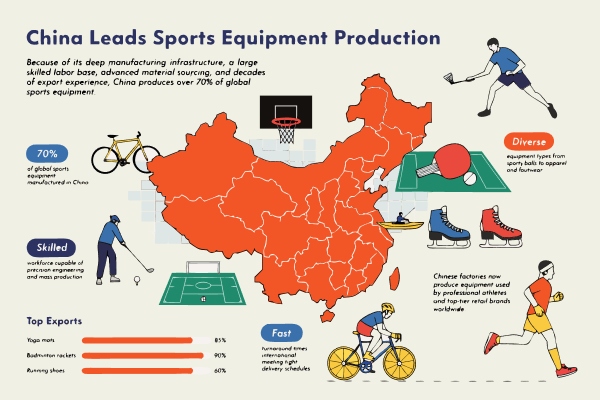
China leads in sports equipment production1 because of its deep manufacturing infrastructure2, large skilled labor base, advanced material sourcing, and decades of export experience. Chinese factories now produce equipment used by professional athletes and top-tier retail brands worldwide.
I have been inside many factories across China. The difference between a mid-tier factory and a high-spec factory is not always visible from the outside. It shows in the materials used, the process controls in place, and the experience of the engineering team. At PDK, we run five dedicated production lines for padel equipment. Each line is set up for a specific product category. That level of focus is only possible because of the manufacturing ecosystem China has built over decades.
What Makes China’s Manufacturing Ecosystem So Strong?
China’s advantage is not just low cost. That is a common mistake people make when they think about Chinese manufacturing. The real advantage is depth. China has built a full supply chain for sports equipment that almost no other country can match.
| Advantage | What It Means for You | Example in Padel |
|---|---|---|
| Material sourcing | Raw materials are local and fast | Carbon fiber, EVA foam, fiberglass all sourced domestically |
| Tooling and mold capability | Complex shapes made faster and cheaper | Custom racket molds ready in 3–5 weeks |
| Skilled labor pool | Experienced workers in composite manufacturing | Hand-layup carbon fiber teams with 5–10 years experience |
| Volume capacity | Large orders handled without delay | 5,000+ rackets per month per production line |
| Export infrastructure | Shipping, documentation, compliance ready | Direct export to EU, US, Middle East markets |
| R&D investment | Factories invest in new materials and processes | New foam cores, textured surfaces, hybrid frame designs |
The material sourcing point is one that many buyers overlook. Because carbon fiber suppliers, foam manufacturers, and frame component producers are all within short distance of most padel factories in China, lead times are shorter and material quality is more consistent. A factory in Europe or South America often waits weeks for raw materials that a Chinese factory receives in days.
I remember a conversation I had with a category manager from the Netherlands. He had been sourcing padel rackets from a European brand at a high price. His margin was under 20%. He was looking for a way to offer the same quality level under his own brand at a better price. After we sent him samples and a full material spec sheet, he told me the quality was equal or better in several areas. He placed his first OEM order three weeks later. That story is not unusual. It is what happens when a buyer looks past the old assumption and checks the actual product.
What Custom Branding Options Does PDK Offer for OEM Rackets?
Private label is one of the strongest business moves a distributor can make. Your own brand gives you pricing power. It builds customer loyalty. It removes dependence on third-party brands that can change terms at any time.
PDK offers full OEM and private-label support3 for padel rackets, including custom logo placement4, racket shape selection, color design, frame material specification5, core foam density, grip style, and custom packaging6. All customization options are available from a minimum order quantity that works for regional distributors.
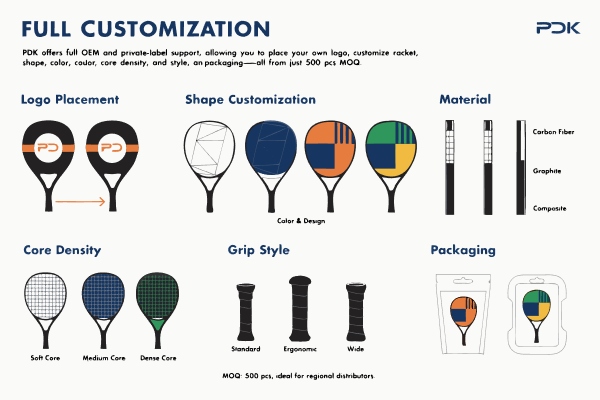
When I speak with distributors for the first time, they often expect customization to mean just putting a logo on an existing product. That is one option. But PDK offers much more than that. A distributor can build a racket specification from the ground up if they want to. They can choose the frame shape, the core material, the surface texture, the weight range, the balance point, the grip size, and the full visual identity. The final product is theirs.
What Are the Full Customization Options Available at PDK?
I want to be specific here because vague promises about customization are common in this industry. Below is a real breakdown of what PDK can customize on a padel racket order.
| Customization Area | Options Available | Notes |
|---|---|---|
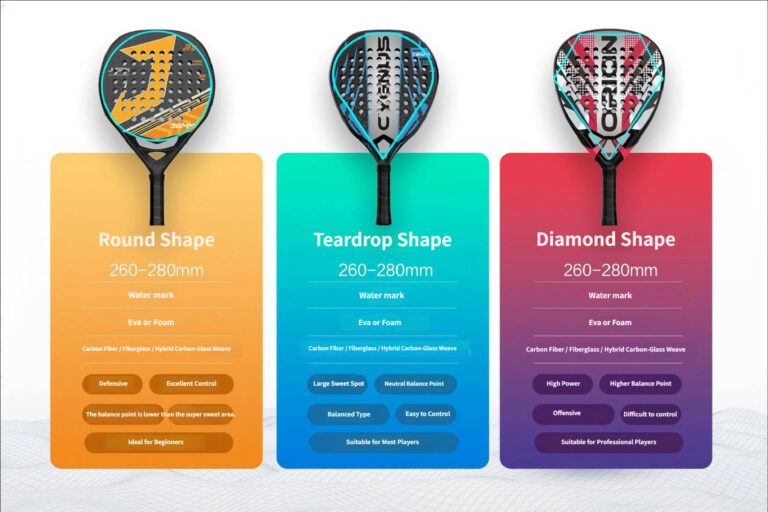
| Racket shape | Round, teardrop, diamond | Each shape has different molds available |
| Frame material | Fiberglass, carbon fiber, hybrid | Carbon fiber adds cost but improves performance |
| Core material | EVA soft, EVA medium, EVA hard, FOAM | Density affects feel and power |
| Surface texture | Smooth, rough, 3D textured | Textured surfaces affect spin and grip |
| Weight range | 340g–390g | Specified per order in 5g increments |
| Balance point | Adjustable within mold constraints | Head-heavy or handle-heavy options |
| Logo placement | Full racket face, handle, frame edge | Screen print, heat transfer, or paint fill |
| Color design | Full custom color scheme | Pantone matching available |
| Grip | Perforated, ribbed, custom color | Grip material and length adjustable |
| Packaging | Custom box, bag, sleeve | Full print packaging with your brand |
The minimum order quantity at PDK is flexible. For standard models with logo customization only, MOQ starts at 50 units. For fully custom mold rackets, MOQ is higher because tooling costs are involved. I always recommend that new clients start with a logo-customized version of one of our existing models. This lets them test the market without a large upfront investment. If the product sells well, we move to a fully custom spec in the next order cycle.
How Does PDK Control Quality Across OEM Padel Racket Production?
Quality control is the biggest concern I hear from buyers considering Chinese manufacturing for the first time. It is a fair concern. Without proper control, quality can vary between batches. The key is knowing what systems a factory has in place before you order.
PDK uses a multi-stage quality control process that covers raw material inspection, in-process checks at each production stage, finished product testing, and pre-shipment inspection. All rackets are tested for weight, balance, delamination, and structural integrity before leaving the factory.
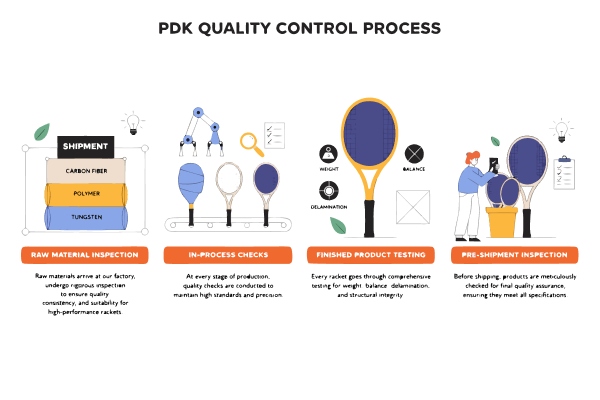
Quality control at PDK is not a final check at the end of the line. It is built into every stage of production. This matters because catching a problem at the raw material stage costs almost nothing to fix. Catching it after the racket is finished costs time, material, and labor. Our team is trained to check at every stage, not just at the end.
What Does PDK’s Quality Control Process Look Like Step by Step?
Here is the actual process we follow for every OEM padel racket order at PDK.
| Stage | What Is Checked | Who Checks It |
|---|---|---|
| Raw material intake | Carbon fiber grade, foam density, resin quality | QC team with material spec sheet |
| Mold layup | Layer count, fiber orientation, resin distribution | Line supervisor per batch |
| Curing | Temperature curve, time, pressure | Automated monitoring + QC log |
| Post-cure demolding | Surface defects, shape accuracy, edge quality | QC team visual inspection |
| Foam core installation | Core alignment, bonding strength | Assembly team + pull test |
| Weight and balance check | Weight within ±5g of spec, balance within ±3mm | QC team with calibrated scale |
| Surface finishing | Paint adhesion, logo clarity, texture consistency | QC team visual and tactile check |
| Structural testing | Drop test, flex test, delamination check | Sample units from each batch |
| Pre-shipment inspection | Full batch count, packaging integrity, label accuracy | Senior QC + optional third-party inspection |
The structural testing step is one that many buyers do not ask about but should. We take sample units from each batch and run a drop test from 1.5 meters and a flex test on the frame. If any unit fails, the batch is held and reviewed. This has happened before. When it does, we do not ship. We fix the problem first.
For buyers who want extra assurance, PDK also supports third-party pre-shipment inspection. Companies like SGS or Bureau Veritas can be arranged by the buyer or by us. This gives an independent check before goods leave the factory. I recommend this for first-time orders. It builds trust and removes uncertainty on both sides.
Conclusion
China leads in OEM padel racket manufacturing because of its material depth, production capacity, and quality systems. PDK offers full customization, flexible MOQ, and multi-stage quality control built for serious distributors.
-
Explore this link to understand the factors that make China a powerhouse in sports equipment manufacturing. ↩
-
Discover how China’s robust manufacturing infrastructure supports high-quality sports equipment production. ↩
-
Understanding OEM and private-label support can enhance your branding strategy and market positioning. ↩
-
Explore how custom logo placement can elevate your brand visibility and customer loyalty. ↩
-
Learn about frame material specifications to optimize performance and durability in your products. ↩
-
Discover how custom packaging can enhance your product appeal and brand identity. ↩