How Can You Increase Spin in Padel Using Equipment and Technique?
Every padel player wants more spin. Spin changes your shot quality, your court control, and how difficult your game is to read. Most players chase spin through technique alone and miss half the answer.
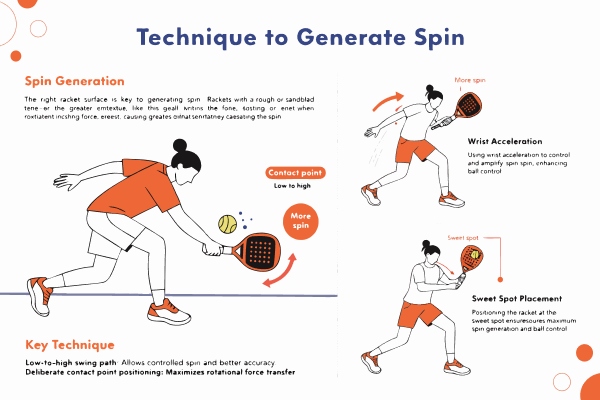
You can increase spin in padel by combining the right racket surface with correct wrist mechanics and deliberate contact point positioning. Rough or sandblasted racket surfaces generate more friction at impact, while proper wrist acceleration and low-to-high swing paths apply maximum rotational force to the ball.
I work with padel equipment manufacturing at PDK every day. Spin is one of the most requested performance features from distributors and club buyers. Players ask their local shop which racket gives the most spin. Coaches ask me which surface finishes we produce that support spin development. I want to answer this properly — covering both the equipment side and the technique side — because neither works without the other.
Which Racket Surfaces Give You the Most Spin Control?
A player with perfect spin technique on a smooth racket will produce less spin than the same player on a textured surface. The racket face is not passive at impact. It actively participates in creating ball rotation.
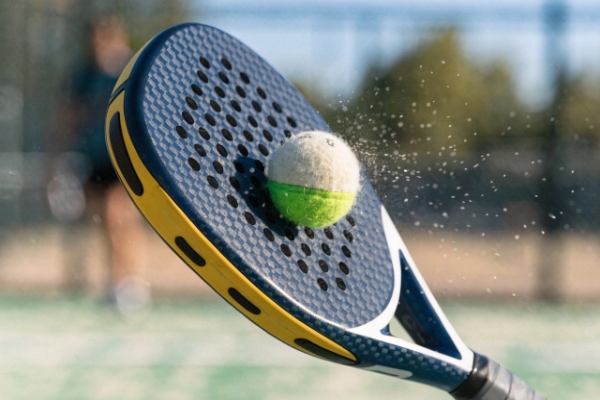
Rough and sandblasted racket surfaces produce the most spin in padel because they create micro-friction1 between the ball felt and the racket face at the point of contact. This friction allows the racket to grip and drag across the ball surface during the swing, generating rotational force that smooth surfaces cannot match.
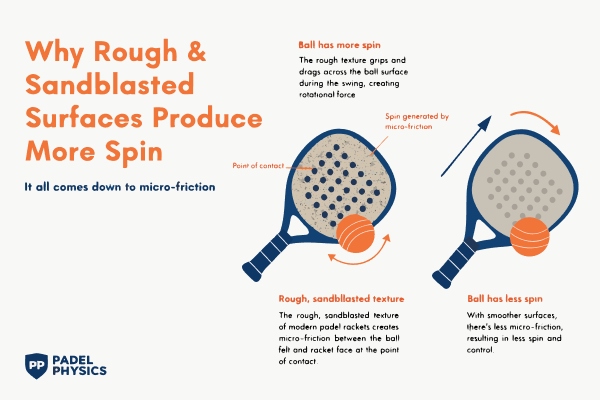
I tested this directly at PDK by using identical racket frames — same shape, same core, same weight distribution — with two different surface finishes. The only variable was the surface. The rough-finished racket produced noticeably more ball rotation on slice shots and topspin drives. The difference was visible in how the ball behaved after bouncing. A ball hit with the rough surface kicked harder off the court and curved more in the air. The smooth surface produced a flatter, faster ball with a more predictable trajectory.
How Do Different Surface Types Compare for Spin Generation?
Not all rough surfaces are the same. The type of texture, how it was applied, and how it wears over time all affect the spin you get out of a racket. Here is a clear breakdown.
| Surface Type | Friction Level | Spin Potential | Durability | Best Use Case |
|---|---|---|---|---|
| Sandblasted fine grit | High | High | Medium | All-round spin players, club level |
| Sandblasted coarse grit | Very high | Very high | Lower | Performance players, heavy spin game |
| Molded 3D texture | Medium–High | Medium–High | Very high | Players who want consistent spin over time |
| Exposed carbon weave | Medium | Medium | High | Technical players, control-focused game |
| Smooth painted surface | Low | Low | High | Power players, flat shot specialists |
The durability2 column is important. Sandblasted surfaces wear faster than molded textures because the rough micro-peaks on a blasted surface are the first thing to smooth out under repeated ball contact. A coarse-grit blasted racket may deliver excellent spin for the first two to three months of heavy use, then gradually lose that edge. A molded 3D texture3 holds its shape longer because the texture is structural, not just surface-level.
For players who train four or more times a week, this wear rate matters. A racket that starts as a high-spin tool and becomes a medium-spin tool over six months is still performing. But the player should know that change is coming. At PDK, we recommend coarse-grit sandblasted surfaces4 to players who compete frequently and replace their racket at least once per season. For club players with lighter use, a molded surface texture offers the best balance of spin performance and longevity.
One thing I always point out to distributors: stocking multiple surface types lets them serve a wider range of customer profiles. A club player looking for their first spin-focused racket needs different advice than a competitive player rebuilding their equipment after a season. Surface type is one of the clearest ways to differentiate a racket range without changing shape or weight.
How Does Wrist Technique and Contact Point Affect Spin Output?
Equipment creates the potential for spin. Technique is what releases that potential. A rough-surfaced racket held by a player with flat, arm-driven swings will not generate spin. The wrist and the contact point5 are where spin is actually produced.
Spin in padel is generated by accelerating the wrist through contact and striking the ball below its center on an upward swing path6. This combination of upward racket direction and wrist snap creates the brushing action that applies topspin7. For slice8, the racket moves downward through a ball struck above center, with the wrist open at contact.
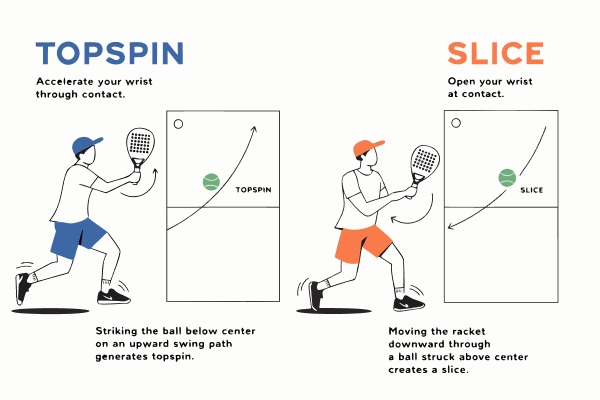
I have watched a lot of padel being played at club level. The most common mistake I see is players trying to swing harder to get more spin. More arm speed alone does not create spin. It creates more power on whatever trajectory the racket is already on. Spin comes from the direction of the swing path relative to the ball, and from wrist acceleration at the critical moment of contact. These are two separate mechanical actions that need to work together.
What Are the Key Mechanical Differences Between Topspin and Slice?
Understanding the mechanics of each spin type helps players practice with intention. Hitting random shots and hoping for spin is not a learning strategy. Knowing exactly what the racket, wrist, and contact point should be doing on each shot makes practice productive.
| Shot Type | Swing Path | Contact Point on Ball | Wrist Position at Contact | Racket Face Angle | Result |
|---|---|---|---|---|---|
| Topspin drive | Low to high | Below center | Snapping forward and upward | Slightly closed (facing down) | Ball dips forward, bounces high |
| Heavy topspin lob | Very low to very high | Well below center | Strong upward snap | Closed | Ball arcs high, kicks deep on bounce |
| Flat slice | High to low | Above center | Firm, open | Open (facing up) | Ball stays low, skids on bounce |
| Backspin drop | Steep downward | Top of ball | Open, cutting under | Very open | Ball floats, loses forward momentum |
| Sidespin | Horizontal across ball | Side of ball | Rolling outward | Vertical | Ball curves left or right in air |
The wrist snap on topspin shots is the part most players underuse. The arm brings the racket to the contact zone. The wrist then fires through the ball, accelerating the face in the upward direction right at impact. This acceleration is what creates the brushing action between the racket surface and the ball. Without the wrist snap, the racket simply pushes through the ball. With it, the racket drags across the ball surface and applies rotational force.
This is also where surface texture becomes critical again. The wrist snap creates relative movement between the racket face and the ball. A rough surface catches the ball during that relative movement. A smooth surface lets the ball slide off without being gripped. The equipment and the technique are working together at exactly the same moment. Improving only one of them gives partial results. Improving both gives a clear, measurable change in spin output.
What Training Drills Actually Help You Develop Better Spin?
Reading about spin technique does not build spin technique. Drilling specific movements in specific contexts builds the muscle memory and timing that make spin a reliable part of a player’s game rather than an occasional accident.
The most effective training drills for padel spin development focus on isolating one variable at a time — swing path, wrist timing, or contact point — before combining them. Short-court drills, wall drills9, and feed drills with a cone target10 are the most practical methods for building consistent spin mechanics at club training level.
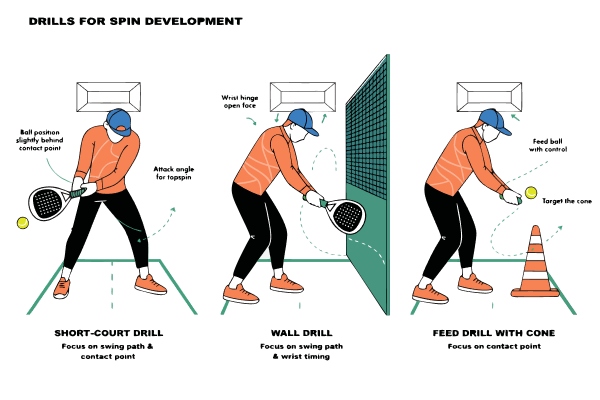
I have spoken with several padel coaches who supply their clubs through PDK. Every one of them said the same thing about spin training: players improve fastest when they can see immediate feedback on whether the drill worked. A drill where the ball behaves differently when the spin is correct — bouncing higher, curving more, staying lower — teaches the body faster than a drill where the outcome looks the same regardless of technique quality.
What Are the Best Drills for Each Type of Spin in Padel?
Here is a set of drills organized by spin type, level, and what the drill is actually training. These are practical and require no special equipment beyond a racket, balls, and a court.
| Drill Name | Spin Type | Setup | What to Focus On | Success Indicator |
|---|---|---|---|---|
| Wall topspin feed | Topspin | Stand 1m from glass wall, feed ball to yourself, hit controlled topspin into wall | Low-to-high swing path, wrist snap at contact | Ball kicks upward off wall on return |
| Cross-court brush drill | Topspin | Two players rally cross-court with focus on topspin | Contact point below ball center, closed face | Ball bounces above shoulder height after landing |
| Short-court slice rally | Slice | Both players stay in service box, rally only slice shots | Open face, high-to-low path, firm wrist | Ball stays below knee height after bounce |
| Cone lob target drill | Topspin lob | Place cone on opposite baseline corner, practice topspin lobs to land on cone | High swing path, strong upward wrist snap | Ball lands within 1m of cone and kicks deep |
| Side wall spin read | All types | Player hits into side wall with topspin or slice, partner reads and returns | Generating clear ball rotation, partner reading spin direction | Partner returns ball cleanly based on spin read |
| Feed and bounce check | Any spin | Coach or partner feeds balls, player hits, both watch first bounce height and direction | Consistent contact point and swing path | Bounce behavior matches intended spin type |
The wall topspin feed drill is the one I recommend most for players who are new to deliberate spin training. The glass wall gives instant visual feedback. If the topspin is real, the ball comes back at a different height and speed than a flat shot. If the ball comes back flat, the player knows the spin was not applied correctly. No coach feedback is needed. The wall tells the player what happened.
The bounce check method in the final drill is something I learned from watching how professional coaches teach spin during warm-ups. They ask players to describe what the ball did after it bounced. A topspin ball accelerates forward and bounces high. A slice ball slows and stays low. A flat ball does neither clearly. By paying attention to the bounce, players start connecting what they did in the swing to what the ball actually did. That connection is what builds spin consistency over time.
Conclusion
Spin in padel comes from three things working together: a rough or textured racket surface, correct wrist acceleration through contact, and a swing path that brushes across the ball. Train all three deliberately and spin becomes a reliable weapon.
-
Learn about micro-friction’s role in spin generation, a key factor for optimizing racket performance. ↩
-
Understand the importance of durability in racket surfaces to maintain consistent performance. ↩
-
Explore the advantages of molded 3D textures for consistent spin and longevity in your racket. ↩
-
Find out why coarse-grit sandblasted surfaces are recommended for competitive players seeking high spin. ↩
-
Exploring the impact of contact point on spin can significantly improve your shot accuracy and effectiveness. ↩
-
Understanding swing path is key to controlling spin, allowing you to place shots more strategically. ↩
-
Learning about topspin mechanics can help you master this essential shot, making your gameplay more dynamic. ↩
-
Mastering the slice technique can add variety to your game, making it harder for opponents to predict your shots. ↩
-
Learn how wall drills can provide instant feedback and enhance your spin skills in padel. ↩
-
Discover innovative training methods using cone targets to improve your spin accuracy. ↩