What Are the Key Factors in Building a High-Quality Padel Court?
A padel court looks simple from the outside. Four walls, a net, some turf. But the courts that last ten years and the ones that fail in two are built with completely different decisions at every stage.
A high-quality padel court requires four core elements: a galvanized steel structure rated for outdoor loads, certified tempered glass panels of correct thickness, artificial turf with sand infill matched to performance standards, and a lighting and drainage system designed for the court’s specific location and climate.
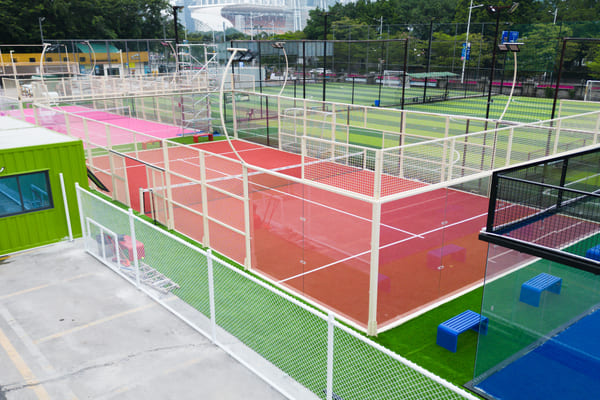
I work at PDK, a manufacturer of padel courts and equipment based in China. We supply courts to clubs, contractors, and distributors across Europe, the Middle East, and the Americas. Every week I speak with buyers who are building their first court or expanding an existing facility. The questions I hear most often are about materials, specifications, and what separates a court that performs well from one that creates problems after installation. I want to answer those questions directly in this guide.
How Do Steel Structure and Glass Quality Determine Court Performance?
Most buyers focus on the visible parts of a court — the turf surface, the glass, the color of the metalwork. The structural decisions underneath those visible elements are what actually determine how long the court lasts and how safe it is to play on.
The steel structure of a padel court must use hot-dip galvanized steel with a minimum coating thickness of 85 microns to resist corrosion in outdoor environments. The glass panels must be certified tempered safety glass, minimum 12mm thick for side walls and 10mm for back walls, tested to EN 12150 or equivalent international standard.
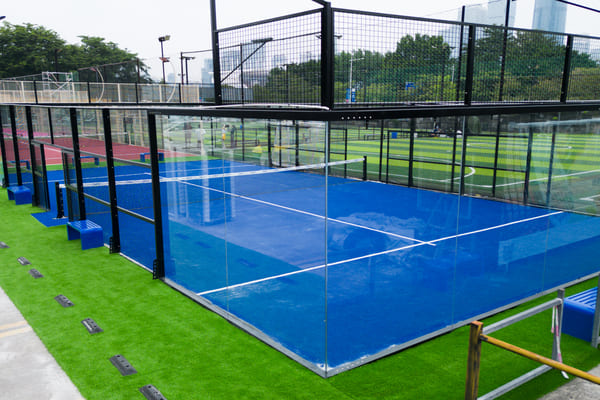
Galvanization is not optional for outdoor courts. It is the baseline requirement.
What Specifications Should You Verify Before Buying a Padel Court Structure?
When evaluating a court supplier, the structural specification document should be requested before pricing discussions. Here is what that document should contain and what each item means in practice.
| Specification Item | Minimum Standard | Why It Matters | What to Ask the Supplier |
|---|---|---|---|
| Steel tube material | S235 or S355 structural steel | Determines load capacity and rigidity | Request material certification, not just product description |
| Galvanization method | Hot-dip galvanized, 85+ micron coating | Determines corrosion resistance over time | Ask for coating thickness test report |
| Glass type | Fully tempered safety glass | Breaks into safe fragments on impact | Request EN 12150 or equivalent certification |
| Glass thickness — back wall | Minimum 10mm | Absorbs high-impact shots from baseline play | Ask if tested under dynamic load conditions |
| Glass thickness — side wall | Minimum 12mm | Higher stress point due to wall-play contact | Verify with product data sheet |
| Panel fixing system | Rubber gasket with stainless steel fixing | Prevents glass vibration and stress fractures | Ask if fixings are stainless or zinc-coated |
| Wind load rating | Minimum 120 km/h for open outdoor locations | Critical in coastal or high-altitude sites | Request structural engineering calculation |
| Frame joint connection | Bolted, not welded on-site | Welded on-site joints corrode at weld points | Inspect assembly drawings before ordering |
The wind load rating is one that buyers in coastal areas frequently overlook. A court built in an inland city with low wind exposure can use a lighter frame specification. The same court installed on a seafront or in a mountain resort location faces very different load conditions. PDK provides location-specific engineering calculations for all outdoor court orders. This is standard practice for a serious court manufacturer and should be expected from any supplier you are considering.
The glass panel fixing system is another detail that creates long-term problems when done wrong. Glass panels that are fixed directly to steel without a rubber gasket will vibrate under ball impact. That vibration creates micro-stress points at the fixing locations. Over time, those stress points lead to cracking. The gasket absorbs the impact energy before it reaches the fixing point. It is a small component with a large function. Ask any potential supplier specifically how their panels are fixed to the frame, and ask to see a cross-section diagram if the answer is unclear.
How Does Artificial Turf Selection Affect Playability and Maintenance?
The turf surface is the part of the court that players interact with on every point. It affects foot grip, ball bounce, physical comfort, and how the court wears over years of play. A wrong turf choice does not just affect performance. It affects the safety of the players on the court.
Padel court artificial turf should use monofilament polyethylene fibres with a pile height of 10–12mm and silica sand infill to a depth that leaves 3–4mm of fibre above the sand surface. This combination delivers the correct ball bounce speed, foot stability, and slide resistance required by international padel standards.
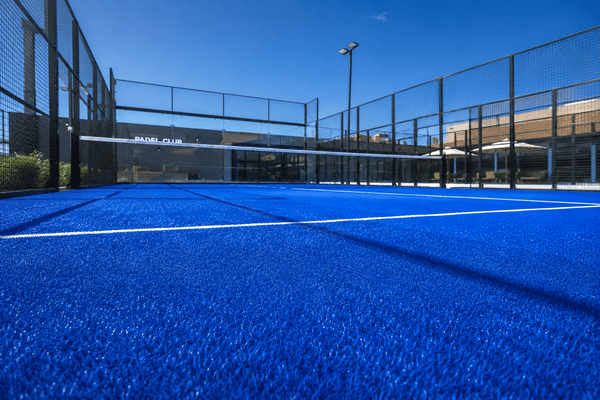
I have played on courts with turf that was too soft, too hard, too fibrous, and too compacted. Each problem creates a different issue. Too soft and the ball bounces inconsistently. Too hard and the surface puts stress on knees and ankles during lateral movement. Too fibrous without enough infill and the surface grabs at shoes in a way that increases ankle injury risk. The turf specification is not a cosmetic decision. It is a playing safety decision.
What Are the Key Variables in Padel Court Turf Specification?
Turf for padel courts is not the same as turf for football or tennis. It is a specific product category with its own performance requirements. Here is how the key variables interact and what happens when any one of them is wrong.
| Turf Variable | Recommended Specification | Effect If Too High | Effect If Too Low |
|---|---|---|---|
| Pile height | 10–12mm | Ball bounces too high, unpredictable | Ball stays too low, fast court, hard surface feel |
| Fibre material | Monofilament polyethylene | N/A — this is the correct material | Stiffer fibres irritate skin on slides, wear faster |
| Fibre density | 16,000–20,000 fibres per m² | Surface too dense, grabs shoes | Sparse surface, infill shifts under play |
| Sand infill depth | Leave 3–4mm fibre above sand | Sand too shallow, surface too fast | Sand too deep, fibres buried, no grip |
| Sand grain size | 0.4–0.8mm silica sand | Coarser sand shifts under lateral movement | Fine sand compacts, surface becomes hard |
| UV stabilization | Required for outdoor courts | N/A — always required outdoor | Fibre degrades within 1–2 years in direct sun |
| Shock pad underlay | 10–12mm foam underlay recommended | Over-cushioned surface, ball response unpredictable | No underlay, hard on joints, fast court feel |
The shock pad underlay is a component many buyers skip to reduce cost. I understand the budget pressure. But the underlay does two things that are difficult to recover from if they are absent. First, it protects the players’ joints. Padel involves a lot of lateral movement and sudden stops. Playing for years on a hard surface without underlay adds cumulative stress to knees and hips. Second, the underlay creates consistent ball bounce by providing a uniform surface beneath the turf. Without it, any irregularity in the concrete base underneath the court is felt in the turf surface above. Padel is a game of precise ball control. Inconsistent bounce from a poor base surface makes that precision harder to achieve.
At PDK, we supply turf packages that include the shock pad underlay as a standard component. Buyers who want to reduce initial cost can remove it, but we always explain what they are removing and why it matters. An informed buyer makes a better long-term decision for their facility.
Why Do Lighting and Drainage Systems Define Long-Term Court Quality?
A padel court can have a perfect structure and excellent turf, and still fail as a playing facility if the lighting is poor or the drainage is inadequate. These two systems determine whether the court is usable in the real conditions it faces — evening play, rain, seasonal weather changes.
Padel court lighting requires a minimum illuminance of 300 lux at court level for recreational play and 500 lux for competitive or televised play, delivered by LED fixtures positioned to eliminate shadows and glare across the playing surface. Drainage must remove water completely within 30 minutes of rain to allow safe resumption of play.
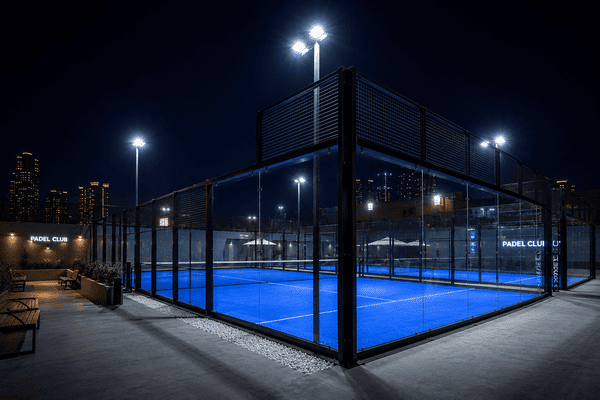
Evening play represents the majority of court usage time in most markets. Players work during the day. They book courts from 6pm to 10pm. A court with poor lighting is a facility that loses bookings every evening. I have seen clubs invest heavily in beautiful court structures and then install inadequate lighting because it was the last item on the budget. The court looks excellent at noon. At 8pm it is barely usable. The lighting decision is as commercial as it is technical.
What Are the Critical Technical Requirements for Court Lighting and Drainage?
Both lighting and drainage have technical requirements that must be met at the design stage. Changes made after installation are expensive. Here is what to specify before the court is built.
| System | Specification Requirement | Failure Consequence | Design Stage Decision |
|---|---|---|---|
| Lighting — lux level | 300 lux recreational, 500 lux competitive | Shadows on court, eye strain, ball tracking difficulty | Calculate fixture count and position in lighting plan before installation |
| Lighting — fixture position | Fixtures above and outside court boundary | Glare directly into players’ eyes on overhead shots | Avoid fixtures directly above net or baseline |
| Lighting — colour temperature | 4000–5000K (cool white to daylight) | Poor ball visibility in yellow or warm light | Specify LED colour temperature in procurement |
| Lighting — LED rating | IP65 minimum for outdoor fixtures | Water ingress failure within first wet season | Verify IP rating on product data sheet |
| Lighting — energy system | Smart control with dimming option | High operating costs, no flexibility for low-use hours | Include controller in lighting system specification |
| Drainage — surface gradient | 0.5–1% slope toward drainage channels | Water pools on surface, slippery court, extended downtime | Build gradient into concrete base design |
| Drainage — channel position | Perimeter channels on all four sides | Water collects at corners, turf lifts at edges | Specify channel placement in civil works drawings |
| Drainage — flow rate | Channel capacity to clear 50mm/hour rainfall | Court unusable after moderate rain | Calculate based on local rainfall data |
| Drainage — turf permeability | Turf must allow water to pass through | Surface water stays on top, court closed for hours | Verify turf permeability rating with supplier |
The lighting fixture position is a detail that is frequently wrong in courts that were designed without a lighting specialist involved. Fixtures placed directly above the baseline, or above the net zone, create glare conditions on lobs, smashes, and any overhead shot. Players report this as a serious comfort and safety issue. The ball becomes hard to track against a bright light source directly in the line of sight. Correct fixture positioning places the lights to the side and above the court boundary, angled inward. This delivers the required lux level without putting any fixture in a player’s direct sightline during normal play.
The drainage gradient is another detail that must be built into the civil works before any court structure goes up. A concrete base that is perfectly flat will pool water after rain. The 0.5–1% slope sounds small, but it is the difference between a court that drains in twenty minutes and one that sits with standing water for hours. This gradient cannot be added retrospectively. It must be in the concrete base design from the beginning. At PDK, our court installation packages include civil works specifications as a standard document. We provide this to the contractor before any groundwork begins. It is one of the most common sources of post-installation problems when it is not addressed early.
Conclusion
A high-quality padel court is built through correct decisions on structure, glass, turf, lighting, and drainage — in that order. Each element supports the next, and cutting corners on any one of them creates problems that are expensive and difficult to reverse.