Why Are Sports Clubs Adding Padel Courts in 2026?
Sports clubs are making the same decision across Europe, the Middle East, and Latin America right now. They are adding padel courts. Not one or two. Multiple courts, sometimes entire dedicated facilities.
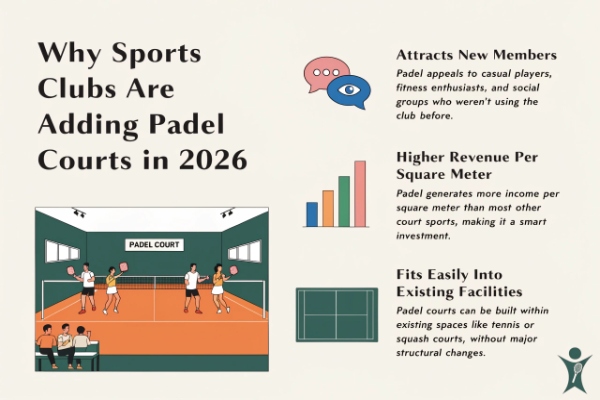
Sports clubs are adding padel courts in 2026 because padel delivers three simultaneous business advantages: it attracts new members who were not using the club before, it generates higher revenue per square meter than most other court sports, and it fits easily into existing multi-sport facilities without requiring major structural changes.
I work at PDK, where we manufacture and supply padel courts to clubs, contractors, and distributors worldwide. In 2025 and into 2026, the volume of inquiries from sports facility operators has increased significantly. The buyers are not all the same type. Some run tennis clubs. Some operate gyms. Some manage multi-sport complexes. But the reason they are enquiring is the same. They want padel courts, and they want them built correctly and quickly. I want to explain what is driving this decision from the club operator’s perspective — because understanding it helps everyone in the supply chain respond to the opportunity correctly.
How Is Increasing Consumer Interest in Padel Changing What Clubs Must Offer?
A sports club that ignores what its members want eventually loses those members to a club that listens. In 2026, members across multiple markets are asking for padel. The clubs that have already added courts are reporting new memberships, increased visit frequency, and longer retention periods. The clubs that have not yet added courts are watching those results and making the decision to act.
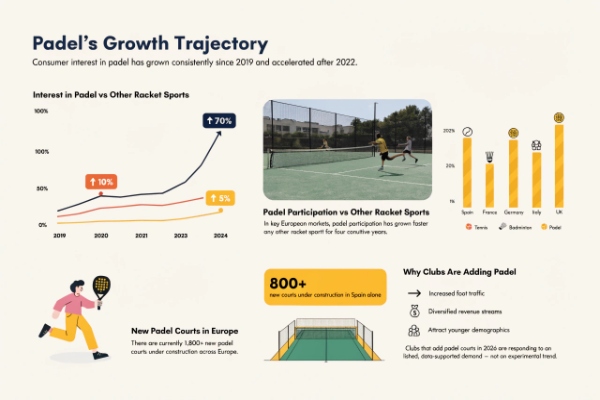
Consumer interest in padel has grown consistently since 2019 and accelerated after 2022. In key European markets, padel participation has grown faster than any other racket sport for four consecutive years. Clubs that add padel courts in 2026 are responding to an established, data-supported demand — not an experimental trend.
I spoke with a club manager in the Netherlands last year. She told me that her members had been asking about padel for two years before the club finally built two courts. Within three months of opening, both courts were fully booked every evening. She added two more courts six months later. The demand was not created by the club’s marketing. It was already there. The club just had to build the facility to meet it.
What Consumer Behavior Data Supports the Decision to Add Padel Courts?
Club operators make investment decisions based on data. The consumer behavior data around padel is now strong enough to support a clear investment case. Here is the evidence that experienced club managers and facility developers are using.
| Consumer Data Point | What the Data Shows | Implication for Club Operators |
|---|---|---|
| Global player growth | Over 25 million players worldwide, up from 5 million in 2008 | Addressable market is large and still expanding |
| Age demographic | Core players aged 25–55, high disposable income bracket | Target demographic matches typical club membership profile |
| Session frequency | Padel players book courts 2–3 times per week on average | High repeat usage drives consistent court revenue |
| Social format effect | Doubles format means one booking brings four players | Each court booking generates four-person club footfall |
| New player conversion | Beginner-to-regular conversion rate higher than tennis or squash | Padel retains new players better than competing court sports |
| Gender participation | Close to 50/50 male/female participation split | Broader demographic appeal than most racket sports |
| Search volume trends | Online searches for padel courts grew over 200% in Europe from 2021 to 2024 | Unmet demand in markets where supply has not kept pace with interest |
The doubles format effect is one that club managers often underestimate when they first model the revenue. A tennis court booked by two singles players generates two memberships. A padel court booked for a doubles match generates four memberships. The social nature of padel means that players rarely come alone. They bring friends, partners, and colleagues. Each new player introduced to the club through padel is a potential new member. The court becomes a recruitment tool as well as a revenue source.
The new player conversion data is also important. Padel’s low learning curve means that players who try the sport for the first time at a club event or open day are significantly more likely to book a second session than players who try tennis for the first time. A club that uses padel as an entry-level sport can build its membership base more efficiently than a club that relies on sports with steeper learning curves. This is a structural advantage that affects the long-term economics of any facility that adds padel.
How Do Padel Courts Generate Higher Venue Utilization and Revenue?
Adding a sport that members enjoy is one business argument. Adding a sport that generates strong financial returns per square meter of facility space is a different and more compelling business argument. Padel makes both arguments at the same time.
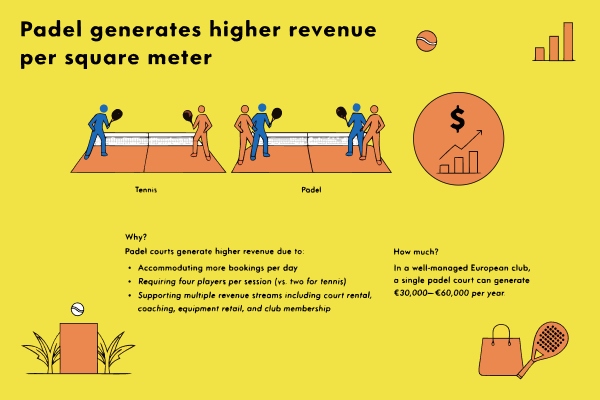
Padel courts generate higher revenue per square meter than tennis courts and most other court sport surfaces because they accommodate more bookings per day, require four players per session rather than two, and support multiple revenue streams including court rental, coaching, equipment retail, and club membership. A single padel court can generate €30,000–€60,000 per year in a well-managed European club.
The revenue figure I gave above is based on real conversations with club operators who supply through PDK. The range is wide because it depends on location, pricing, and how well the club manages court utilization. A court in central Madrid with peak-hour pricing and full evening bookings sits at the top of that range. A court in a smaller market with lower pricing and irregular demand sits lower. But even the lower end of that range delivers a return on investment within a defined and manageable timeframe for most operators.
What Are the Revenue Streams a Padel Court Creates for a Sports Club?
The financial model for a padel court is not based on a single income line. It creates multiple revenue streams that work together. Here is how those streams break down and what a realistic model looks like.
| Revenue Stream | How It Works | Revenue Potential | Notes |
|---|---|---|---|
| Court rental — peak hours | Bookings from 6pm to 10pm, highest demand period | €15–€30 per hour per court | 4 hours × 5 weekdays × 52 weeks = high annual base |
| Court rental — off-peak | Morning and afternoon bookings, lower demand | €8–€15 per hour per court | Coaching sessions often fill off-peak slots |
| Group coaching sessions | Instructor-led sessions for 4–8 players on one court | €20–€40 per player per session | Coaching programs drive membership and court use |
| Private lessons | One-on-one or two-on-one coaching | €40–€80 per hour | High margin, coach-dependent revenue |
| Club membership fees | Annual or monthly fee for priority booking access | €50–€150 per month per member | Recurring, predictable revenue stream |
| Equipment retail — rackets | Club pro shop or vending area | €40–€200 per racket sale | Branded stock, margin 30–50% typical |
| Equipment retail — balls and accessories | Balls, bags, grips, shoes | €5–€40 per transaction | Consumable items generate repeat purchase |
| Corporate bookings | Company team events, private sessions | €100–€300 per event | Premium pricing, off-peak slot utilization |
| Padel tournaments | Entry fees, sponsorship, F&B on event days | Variable | High marketing value in addition to direct revenue |
| Food and beverage uplift | Additional spend by players before and after play | Variable by facility | Padel sessions are social, F&B consumption is high |
The corporate bookings line is one that club operators in major cities are developing quickly. Companies use padel sessions as team-building events. A group of eight to twelve employees booking two courts for two hours on a Friday afternoon is a premium booking that fills off-peak time at above-standard rates. The social, doubles format of padel makes it naturally suited to corporate team events in a way that single-player sports are not. A club that actively markets padel packages to local businesses adds a revenue stream that is largely independent of its regular membership base.
The equipment retail line is also relevant for distributors reading this. As more clubs add padel courts, more clubs are also opening or expanding pro shops. A club pro shop is a captive retail environment. Players arrive, play, and then browse. They buy balls, replace grips, and eventually upgrade rackets. Distributors who establish supply relationships with club pro shops before the club’s padel operation is fully established lock in a recurring purchase account. The club’s retail buyer does not want to switch suppliers once a reliable relationship is in place.
How Are Multi-Sport Facility Development Trends Shaping the Decision to Add Padel?
Sports clubs are not making padel decisions in isolation. The broader direction of sports facility development is moving toward multi-sport models. A facility that offers padel alongside tennis, fitness, swimming, and other activities serves a wider member base, generates more daily footfall, and builds a stronger community than any single-sport facility can.
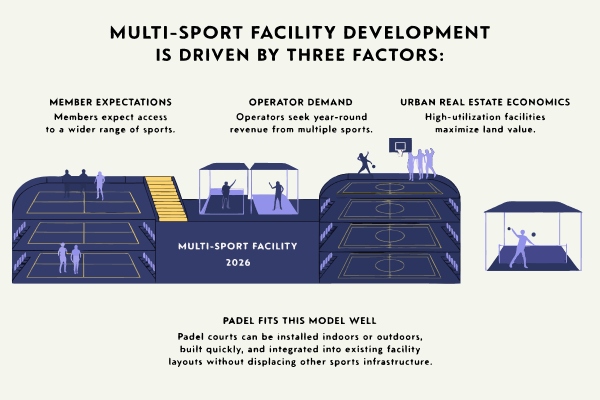
Multi-sport facility development in 2026 is driven by member expectations for variety, operator demand for year-round revenue across multiple sports, and urban real estate economics that favor high-utilization facilities over single-sport venues. Padel fits this model because courts can be installed indoors or outdoors, built quickly, and integrated into existing facility layouts without displacing other sports infrastructure.
I have worked with several facility developers who are building multi-sport complexes from the ground up. In almost every case, padel is now included in the initial facility plan rather than added later as an afterthought. Five years ago, padel was the addition. Now it is often the anchor around which other sports facilities are planned. This shift says something very clear about where the market sees padel in the long-term sports facility landscape.
How Does Padel Compare to Other Sports When Adding Courts to an Existing Facility?
Not every sport can be added to an existing club without major disruption. Some require structural changes. Some require specialist surfaces that conflict with other uses. Some require large footprints that are not available in urban locations. Padel scores well on nearly all of these practical factors.
| Factor | Padel | Tennis | Swimming Pool | Indoor Football | Squash |
|---|---|---|---|---|---|
| Space requirement per unit | 200 m² per court | 650 m² per court | 500 m²+ | 800 m²+ | 75 m² per court |
| Installation time | 2–4 weeks per court | 6–12 weeks per court | 6–18 months | 3–6 months | 4–8 weeks |
| Indoor/outdoor flexibility | Both, easily convertible | Primarily outdoor | Indoor only | Primarily indoor | Indoor only |
| Revenue per m² | High | Medium | Low–Medium | Medium | Medium |
| Player accessibility | High — low learning curve | Low — steep learning curve | Medium | Medium | Medium |
| Social format | Always doubles | Singles or doubles | Individual | Team | Usually singles |
| Equipment retail attachment | High | Medium | Low | Medium | Low |
| Maintenance cost (annual) | Low–Medium | Medium | High | Medium | Low–Medium |
The space requirement comparison is the one that drives the most facility decisions. A tennis court occupies roughly 650 square meters including run-off zones. A padel court requires approximately 200 square meters. In a facility with a fixed available footprint, replacing one tennis court with three padel courts is not just possible — it is often a better use of that space from a revenue and utilization perspective. Three padel courts serve twelve players simultaneously. One tennis court serves two to four.
This space efficiency is also why padel is appearing inside buildings that were never designed for sports use. Disused warehouses, underused parking structures, and large retail units have all been converted into padel facilities in European cities in the last three years. The modular nature of padel court structures — which can be prefabricated and assembled on-site without major civil works in many cases — makes this kind of conversion practical. At PDK, we have supplied courts for indoor facilities in existing buildings where a tennis court would never fit. The sport comes to the players rather than requiring players to travel to dedicated sports zones. This is a meaningful access advantage in dense urban environments where space is expensive and travel time is a barrier to regular sport participation.
Conclusion
Sports clubs are adding padel courts in 2026 because the consumer demand is clear, the financial returns are proven, and padel fits multi-sport facility models better than almost any competing option. The decision is no longer speculative. It is supported by data, revenue models, and the direct experience of clubs that moved early.