The Ultimate Guide to Choosing the Perfect Padel Racket
You walk into a store facing a wall of fifty different rackets. They look similar. The salesperson talks about shapes and weights. You leave more confused than when you arrived.
Choosing the right padel racket requires matching three key factors to your profile: racket shape (round for control, diamond for power, teardrop for balance), weight distribution (lighter and head-heavy for power, heavier and balanced for control), and construction materials aligned with your skill level. Getting these selections right improves performance by 30-40% compared to mismatched equipment.
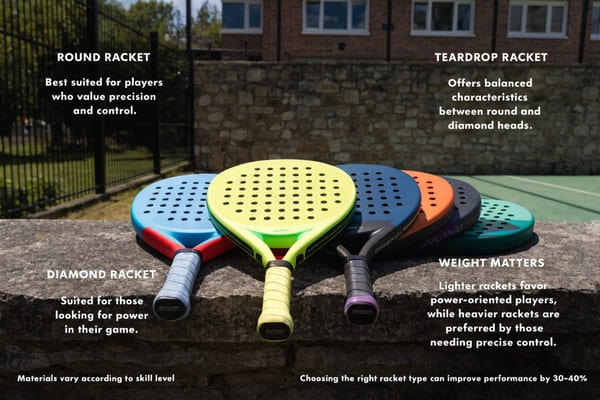
The right racket makes the game more enjoyable and helps players improve faster. The wrong racket causes frustration, limits development, and sometimes leads to injury. Let me walk you through the exact process I use to match players with equipment.
Understanding Racket Shape: Round vs. Diamond vs. Teardrop
Shape determines where the racket’s weight concentrates and how large the sweet spot1 becomes. This affects every shot you hit.
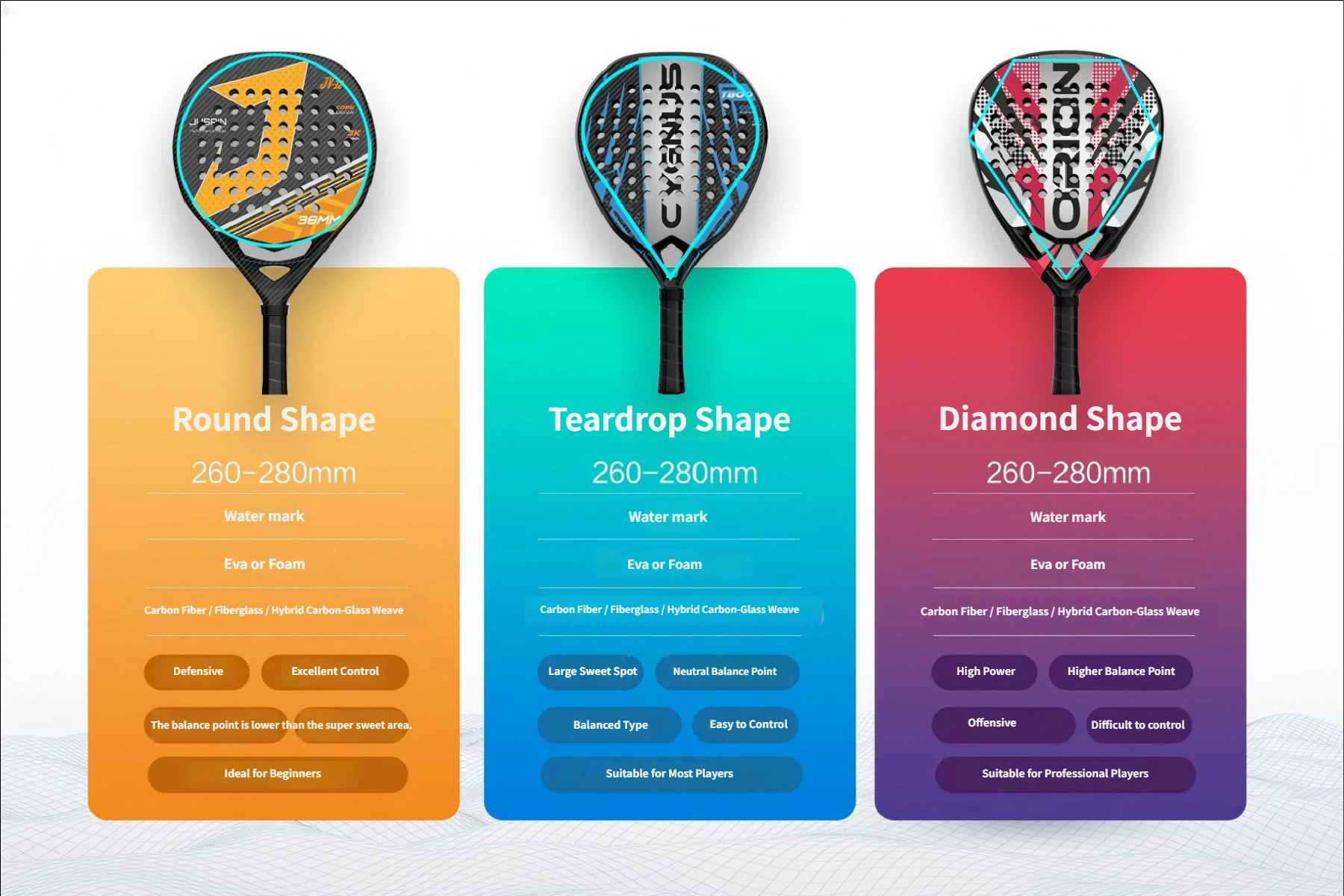
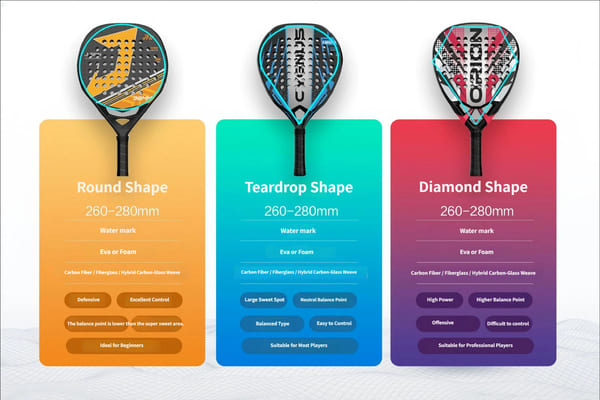
Round rackets2 position the sweet spot1 near the center with balanced weight distribution3, maximizing control4 and forgiveness5 for defensive players and beginners. Diamond rackets6 shift weight toward the top edge, creating a smaller sweet spot1 higher on the face, optimizing power generation7 for aggressive advanced players. Teardrop rackets8 combine characteristics of both shapes, offering moderate power with reasonable control4 for intermediate all-court players.
I remember a customer who bought a diamond racket as his first equipment because he thought the shape looked aggressive. After two weeks, he returned complaining about arm pain and inconsistent hits. His contact point was too low on the face—below the small sweet spot1. We switched him to a round racket. His consistency improved immediately and the pain disappeared.
Round rackets2 feature a circular head shape with maximum width at the center. This geometry places the sweet spot1 8-12cm from the bottom edge, right where most defensive and mid-court shots make contact. The balanced shape distributes weight evenly around the perimeter. Players feel the racket responds similarly regardless of impact location within a reasonable area.
The large sweet spot1 on round rackets matters most for beginners and intermediate players9. New players miss the center frequently. A round racket forgives these mistakes—off-center hits still produce reasonable results. The ball goes roughly where intended, just with slightly less power or spin. This forgiveness5 builds confidence and allows players to focus on footwork and positioning rather than worrying about perfect contact.
Control comes naturally with round shapes. The balanced weight distribution3 responds quickly to wrist and arm adjustments. You can change shot direction easily during the stroke. The racket head follows your hand movement directly without excess momentum pulling it in unwanted directions. Defensive players who need precise placement under pressure benefit most from this responsive characteristic.
| Racket Shape | Sweet Spot Location | Sweet Spot Size | Balance Point | Power Level | Control Level | Best For |
|---|---|---|---|---|---|---|
| Round | Center, 8-12cm from bottom | Large (45-55% of face) | Even to slightly head-light | Low-Medium | Very High | Beginners, defensive players, control4-focused |
| Teardrop | Upper-center, 10-14cm from bottom | Medium (35-45% of face) | Neutral | Medium | Medium-High | Intermediate, all-court players, balanced style |
| Diamond | Upper section, 12-16cm from bottom | Small (25-35% of face) | Head-heavy | High-Very High | Low-Medium | Advanced, aggressive attackers, power-focused |
Diamond rackets6 feature a pointed top with maximum width near the upper third of the face. This shape concentrates weight toward the top edge, creating a head-heavy balance. The sweet spot1 sits higher on the face, positioned where overhead smashes and aggressive volleys make contact. Players who attack frequently and hit from above shoulder height benefit from this design.
Power generation represents the diamond shape’s primary advantage. The concentrated weight increases rotational momentum during swings. When you accelerate the racket, all that top-loaded weight whips through the hitting zone, transferring maximum energy to the ball. Smashes and aggressive groundstrokes gain 15-25% more velocity compared to round rackets at identical swing speeds.
The tradeoff: diamond rackets punish imperfect contact harshly. Miss the small sweet spot1 and the racket twists in your hand. The ball flies in unpredictable directions. Vibration shoots up your arm. This unforgiving nature makes diamond shapes suitable only for players with consistent technique who can reliably contact the upper portion of the racket face.
The diamond rackets primarily for advanced players who favor aggressive attacking styles. We use harder cores (29-31 Shore C) and full carbon faces because players choosing diamond shapes typically have the strength and technique to handle firm, responsive equipment.
Teardrop rackets8 split the difference. The shape widens gradually from bottom to top, creating a sweet spot1 in the upper-center area. Balance falls between round and diamond—typically neutral or slightly head-heavy. This moderate positioning provides some power assistance without sacrificing too much control4 or forgiveness5.
Teardrop shapes suit the largest player segment: intermediates developing their games. These players have outgrown the beginner stage but haven’t committed to a specific playing style yet. The teardrop’s versatility allows them to experiment with attacking and defending without equipment limitations. As their style emerges over 12-18 months, they can move to round or diamond shapes that better match their developed preferences.
I recommend distributors stock teardrop rackets in the 26-28 Shore C core range with hybrid face construction. This combination provides good performance across all shot types while remaining accessible to players with moderate strength and developing technique. These specifications hit the sweet spot1 for retail sales volume10.
One detail many players miss: the same shape designation can perform differently depending on where within that shape category it falls. A "round" racket with slightly elongated sides responds differently from a perfectly circular round design. A "diamond" with a gradual taper feels less extreme than one with sharp angles. When possible, test multiple rackets within your target shape category to find the specific profile that matches your swing mechanics11.
How Weight Affects Control and Power
Weight isn’t just about how heavy the racket feels. Where that weight distributes across the frame changes everything about performance and feel.
Racket weight influences shot quality12 through three mechanisms: total mass determines swing speed and stability (lighter rackets swing faster but twist more, heavier rackets provide stability but require more effort), balance point affects maneuverability13 and power generation (head-heavy increases power through momentum, head-light improves control through quick response), and swing weight combines both factors14, measuring the actual effort required to accelerate the racket through the hitting zone.
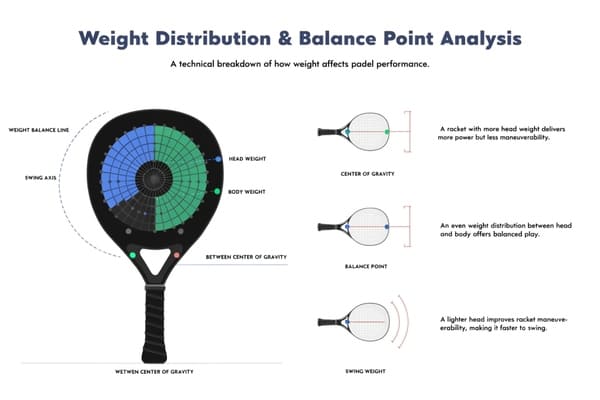
A Dutch distributor once told me his customers complained that "370g rackets feel heavier than 380g rackets." I tested both models. The 370g racket had extreme head-heavy balance. The 380g racket had neutral balance. The lighter racket actually required more effort to swing because all the weight sat at the top. Total weight matters less than weight distribution.
Total weight for adult padel rackets ranges from 345g to 395g. Below 345g, the racket lacks stability for consistent performance. Above 395g, most players tire too quickly during matches. The optimal range depends on player strength, gender, age, and experience level.
Lightweight rackets (345-365g) offer faster swing speeds. Players can accelerate the racket more quickly, improving reaction time on fast exchanges. This speed advantage helps players who struggle to generate velocity through technique alone. The downside: lightweight rackets twist more on off-center hits and provide less resistance against powerful incoming shots. The racket gets pushed around rather than providing stable rebound.
Medium weight rackets (365-375g) balance swing speed and stability. Most intermediate and advanced players find this range comfortable for 90-minute match play without excessive fatigue. The weight provides enough mass to stabilize the racket on mishits while remaining maneuverable enough for quick defensive reactions. At Padel Keeper, approximately 60% of our production falls in this weight range because it suits the broadest player population.
| Weight Range | Swing Speed | Stability | Fatigue Level | Power Assistance | Control | Best For |
|---|---|---|---|---|---|---|
| 345-360g (Light) | Very Fast | Low | Low | High through speed | Medium | Beginners, women, senior players, quick reactions |
| 360-370g (Medium-Light) | Fast | Medium | Low-Medium | Medium-High | Medium-High | Intermediate, lighter build players |
| 370-380g (Medium) | Moderate | High | Medium | Medium | High | Advanced, average build players |
| 380-390g (Medium-Heavy) | Slow | Very High | Medium-High | Low-Medium | Very High | Competitive, strong players |
| 390-400g (Heavy) | Very Slow | Maximum | High | Low | Maximum | Professional, exceptional strength |
Balance point matters more than total weight for how the racket actually feels during play. Balance is measured as the distance from the butt cap to the point where the racket balances on a single support point. Even balance typically sits at 260-265mm. Head-heavy balance extends beyond 270mm. Head-light balance falls below 255mm.
Head-heavy balance (common in diamond shapes) creates power through momentum. The concentrated weight at the racket head accelerates through impact with more kinetic energy. Players describe this as the racket "doing the work." The tradeoff: head-heavy rackets respond slowly to directional changes. Quick volleys and defensive blocks become more difficult because the heavy head wants to continue moving in its current direction.
Head-light balance (common in round shapes) improves control through maneuverability. The weight concentrates near your hand, allowing fast rotations and precise angle adjustments. The racket follows your wrist movement immediately. Defensive players who need to change shot direction rapidly during extended rallies benefit most from head-light designs.
Swing weight (measured in kg·cm²) combines total weight and balance into a single number representing how much effort accelerating the racket requires. Two rackets might weigh 370g, but if one has head-heavy balance (280mm) and the other has head-light balance (250mm), the head-heavy model might have 30% higher swing weight despite identical total mass.
I measure swing weight on all our production runs. For beginners and recreational players, I target 270-290 kg·cm². For intermediate competitive players, 290-310 kg·cm² provides good performance. Advanced and professional players can handle 310-340 kg·cm² because their developed technique and strength generate the necessary acceleration.
Gender differences affect weight recommendations significantly. Women generally have less upper body strength than men. A 375g racket that feels comfortable to a male intermediate player might exhaust a female intermediate player after 45 minutes. We produce women-specific models in the 355-370g range, typically 10-15g lighter than equivalent men’s models while maintaining similar performance characteristics through adjusted core and face specifications.
Age matters beyond strength considerations. Younger players (under 30) typically have faster twitch muscle response, allowing them to handle heavier swing weights more comfortably. Older players (over 50) benefit from lighter overall weight and neutral to head-light balance regardless of skill level, reducing joint stress during extended play.
One practical test I recommend: hold the racket at arm’s length horizontally for 30 seconds. If your arm shakes significantly or you struggle to maintain position, the racket is too heavy or too head-heavy for your current strength level. You’ll fatigue quickly during matches and likely develop poor technique compensations that lead to injury.
Players often ask if they should "grow into" a heavier racket. My answer: no. Use equipment matched to your current capabilities15. As you develop strength and technique over 6-12 months, reassess and move up in weight if appropriate. Starting with equipment too heavy for your current condition increases injury risk and slows skill development because you can’t execute proper mechanics.
Best Rackets for Beginners, Intermediate, and Pro Players
Different skill levels need fundamentally different equipment characteristics. What helps a beginner often hurts an advanced player, and vice versa.
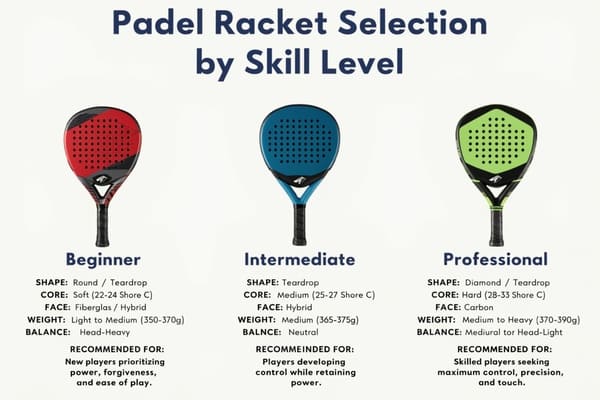
Beginners need round or teardrop shapes with soft cores (22-24 Shore C), fiberglass or hybrid faces, light to medium weight (350-370g), and head-heavy balance for maximum power assistance and forgiveness. Intermediate players benefit from teardrop shapes with medium cores (25-27 Shore C), hybrid faces, medium weight (365-375g), and neutral balance for developing control while maintaining power. Advanced and professional players require diamond or teardrop shapes with hard cores (28-33 Shore C), carbon faces, medium to heavy weight (370-390g), and neutral to head-light balance for maximum control and touch.
I helped a sports club owner in Spain select inventory for a new facility. He wanted to stock only premium professional-level rackets because they had the highest margins. I convinced him to carry a range across skill levels. Within three months, the beginner and intermediate models generated 75% of his sales volume. Professional models sold occasionally, but the broader range served his actual customer base.
Beginners (0-12 months playing) face specific challenges that equipment should address. They lack consistent swing mechanics, making off-center contact frequent. They haven’t developed upper body strength for power generation. They struggle with timing and positioning. The right racket compensates for these developing skills rather than requiring them.
Round shape benefits beginners through the large forgiving sweet spot. When they miss center by 3-5cm—which happens on 60-80% of shots initially—the racket still produces reasonable results. The ball goes roughly where intended. This forgiveness builds confidence and allows focus on footwork and court positioning rather than perfect contact.
Soft cores (22-24 Shore C) help beginners generate power without requiring maximum effort. The deep compression stores and releases energy, adding velocity to slower swings. A beginner swinging at 35 km/h might produce ball speed of 45-50 km/h thanks to core assistance. This power boost makes the game more enjoyable because balls reach the back wall and shots feel solid even with developing technique.
| Skill Level | Shape | Core Hardness | Face Material | Weight | Balance | Price Range | Key Benefit |
|---|---|---|---|---|---|---|---|
| Beginner (0-1 year) | Round | 22-24 Shore C | Fiberglass or Hybrid | 350-365g | Head-heavy (+8 to +12mm) | $60-120 | Maximum forgiveness and power assistance |
| Intermediate (1-3 years) | Teardrop | 25-27 Shore C | Hybrid Carbon-Fiberglass | 365-375g | Neutral (±3mm) | $100-180 | Balanced performance for developing skills |
| Advanced (3-5 years) | Teardrop or Diamond | 28-30 Shore C | Carbon Fiber | 370-385g | Neutral to Head-light | $150-250 | High control with adequate power |
| Professional (5+ years) | Diamond | 30-33 Shore C | Premium Carbon | 375-395g | Head-light (-5 to +2mm) | $200-350 | Maximum control, touch, and durability |
Light weight (350-365g) reduces fatigue for beginners still building arm and shoulder endurance. Many new players experience soreness after 45-60 minutes of play. Heavier rackets accelerate this fatigue, reducing practice time and increasing injury risk. Light rackets allow longer play sessions, speeding skill development through additional repetitions.
Head-heavy balance provides power boost through momentum without requiring the player to generate maximum swing speed. The weight concentration at the racket head carries energy into the impact zone. Beginners can swing at 70% maximum effort and still produce effective shots thanks to this momentum assistance.
At Padel Keeper, our beginner models use 22-23 Shore C EVA cores, fiberglass faces with one carbon layer for durability, 355-365g weight, and +10mm head-heavy balance. We price these at $75-95 wholesale because beginners represent a cost-sensitive segment who aren’t yet committed to long-term participation. Lower entry prices reduce barriers and convert more people into regular players.
Intermediate players (1-3 years experience) have developed basic consistency but need equipment supporting continued improvement. They’re learning shot variety, developing strategic understanding, and refining technique. The right racket allows experimentation without limiting options as skills evolve.
Teardrop shape suits intermediates because it doesn’t force commitment to attacking or defensive style. The moderate sweet spot and neutral balance work well for groundstrokes, volleys, and occasional smashes. As players discover whether they prefer aggressive or defensive approaches, they can transition to diamond or round shapes respectively in their next purchase.
Medium cores (25-27 Shore C) provide balanced characteristics. The moderate hardness offers some power assistance for developing players while beginning to reward improved technique with better control. Players start feeling how swing adjustments affect ball placement
-
Understanding the sweet spot can significantly improve your shot accuracy and overall game. ↩ ↩ ↩ ↩ ↩ ↩ ↩ ↩ ↩ ↩
-
Explore the advantages of round rackets, especially for beginners and defensive players, to enhance your game. ↩ ↩
-
Explore how different weight distributions impact your control and power during play. ↩ ↩
-
Control is crucial for precision shots; find out how to choose the right racket for your style. ↩ ↩ ↩ ↩
-
Discover how racket forgiveness can help improve your game, especially as a beginner. ↩ ↩ ↩
-
Learn how diamond rackets can boost your power and performance, ideal for aggressive players. ↩ ↩
-
Learn about the mechanics of power generation to enhance your hitting strength and effectiveness. ↩
-
Discover the unique features of teardrop rackets that cater to intermediate players seeking versatility. ↩ ↩
-
Get insights on selecting the right racket as an intermediate player to enhance your skills. ↩
-
Explore strategies to boost sales in the competitive padel racket market. ↩
-
Understanding swing mechanics is key to selecting the right racket for your playing style. ↩
-
Understanding this can help players choose the right racket for their performance. ↩
-
This resource will clarify how balance affects your game and shot precision. ↩
-
Learn how swing weight can enhance your playing style and efficiency. ↩
-
Discover how using the right equipment can enhance your skill development. ↩