What Is Padel? A Complete Guide for Padel Court Investors and Distributors
Sports facility investors and equipment distributors see padel’s explosive growth but struggle to understand the real business opportunity. They risk investing in the wrong markets or equipment without proper market intelligence.
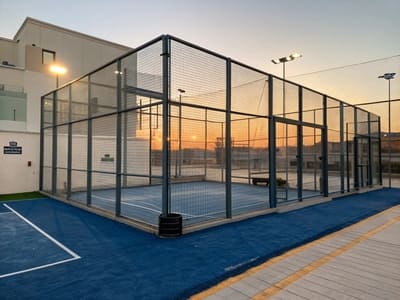
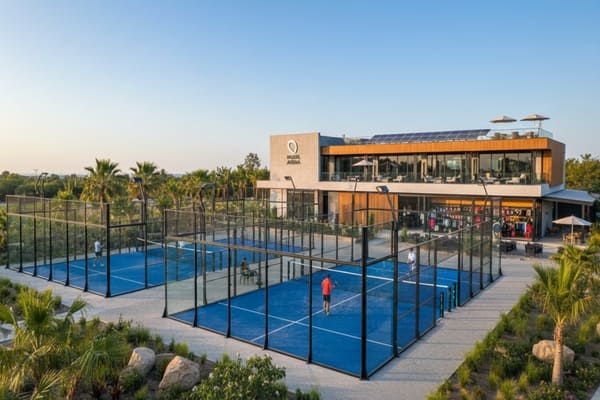
Padel is a racket sport combining tennis and squash elements, played in enclosed glass courts measuring 20×10 meters. The global market is growing 20-30% annually, with courts costing $18,000-45,000 to build and generating 15-25% annual ROI through memberships, court rentals, and retail sales.
I work directly with facility developers and distributors across three continents. The investors who understand padel’s unique business model and market positioning consistently achieve superior returns compared to traditional tennis or sports facilities.
How Much Does It Cost to Build a Padel Court?
Many investors underestimate total project costs and face budget overruns that destroy profitability. Others overspend on unnecessary features that don’t improve revenue generation or player experience.
Building a single padel court costs between $18,000-45,000 depending on quality level, location, and installation complexity. Budget courts use basic materials at $18,000-25,000, mid-range courts with quality glass and turf cost $25,000-35,000, and premium installations with advanced features reach $35,000-45,000.
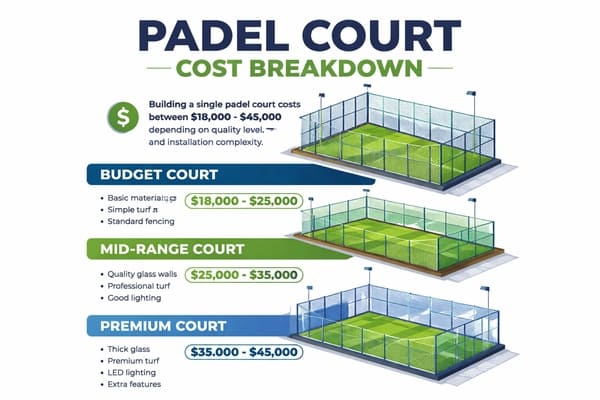
Understanding detailed cost structures helps investors make informed decisions and avoid budget surprises. Here’s the complete breakdown:
Padel Court Construction Cost Analysis
| Cost Component | Budget Range | Mid-Range | Premium Range |
|---|---|---|---|
| Court Structure | $8,000-10,000 | $12,000-15,000 | $18,000-22,000 |
| Glass Panels (12mm) | $4,000-6,000 | $7,000-9,000 | $10,000-13,000 |
| Artificial Turf | $2,500-3,500 | $4,000-5,500 | $6,000-8,000 |
| Lighting System | $1,500-2,000 | $2,500-3,500 | $4,000-6,000 |
| Installation Labor | $2,000-3,500 | $3,500-5,000 | $5,000-7,000 |
| Total Per Court | $18,000-25,000 | $29,000-38,000 | $43,000-56,000 |
The court structure represents the largest single expense and dramatically affects long-term durability. Budget options use galvanized steel frames with basic welding, suitable for indoor facilities with controlled environments. Mid-range structures employ powder-coated steel with reinforced joints for better weather resistance. Premium installations feature hot-dip galvanized or stainless steel frames engineered for coastal areas or extreme climates.
Glass panel quality determines player experience and maintenance costs. Standard 12mm tempered glass provides adequate durability for most installations. However, laminated glass options (two 6mm sheets with interlayer) offer superior safety and acoustic properties for facilities near residential areas. Some premium installations use 10+10mm laminated glass meeting international tournament specifications.
Artificial turf selection impacts both initial costs and operating expenses. Economy turf uses 10-12mm pile height with sand infill, requiring replacement every 3-4 years. Mid-range options feature 12-15mm fibers with sand-rubber infill lasting 5-7 years. Premium turf systems use 15-18mm monofilament fibers with organic infill, providing 8-10 year lifespans with proper maintenance.
Lighting requirements vary based on usage intensity and local regulations. Basic setups use 4-6 LED fixtures providing 300-400 lux, sufficient for recreational play. Tournament-grade installations need 500-750 lux with 8-12 fixtures and anti-glare shields. Energy-efficient LED systems reduce operating costs by 60-70% compared to traditional metal halide lights.
Foundation and site preparation add significant hidden costs often overlooked in initial budgets. Level ground with good drainage requires minimal preparation at $2,000-3,000 per court. Uneven terrain needs excavation and grading at $5,000-8,000. Poor drainage areas require complete subsurface systems adding $8,000-12,000. Urban rooftop installations demand specialized structural engineering at $15,000-25,000 premium.
Permits and regulatory compliance costs vary dramatically by location. Simple installations in permissive jurisdictions need only basic permits at $500-1,500. Complex projects in regulated areas require architectural plans, engineering stamps, environmental assessments, and multiple inspections totaling $5,000-15,000. Some municipalities classify padel courts as tennis facilities with streamlined approval, while others apply stricter building codes.
Is a Padel Court a Good Investment?
Investors worry about market saturation and whether padel’s growth will continue or collapse like other sports fads. They need concrete data on returns and risk factors before committing capital.
Padel courts generate strong investment returns with 15-25% annual ROI1 in growing markets through multiple revenue streams. Courts reach profitability within 18-36 months with proper location selection, pricing strategy, and operational management. The investment succeeds best in urban areas with high disposable income2 and limited existing padel facilities.
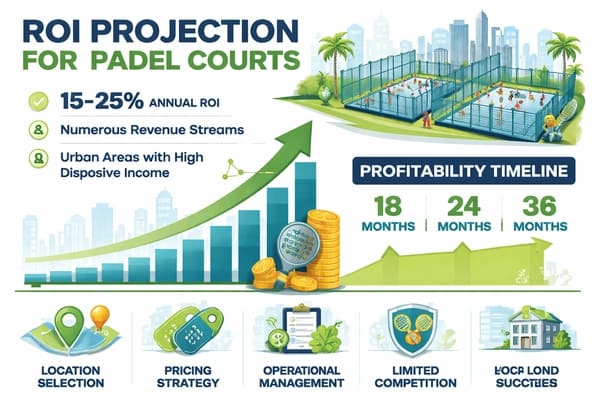
Investment viability depends on multiple factors working together. Here’s my analysis based on real facility data:
Investment Performance Analysis
-
Revenue Generation Potential:
- Peak hour rentals: $25-45 per hour per court
- Off-peak rates: $15-30 per hour per court
- Average utilization: 40-70% in mature markets
- Monthly revenue per court: $2,500-6,000
- Annual revenue potential: $30,000-72,000 per court
-
Operating Cost Structure:
- Electricity (lighting/climate): $150-300 monthly
- Maintenance and repairs: $100-250 monthly
- Staff costs (if applicable): $1,000-3,000 monthly
- Insurance and permits: $100-200 monthly
- Marketing and promotion: $200-500 monthly
- Total monthly operating costs: $1,550-4,250
-
Profitability Timeline:
- Break-even point: 12-24 months for well-located facilities
- Positive cash flow: 6-12 months with membership model
- Full investment recovery: 3-5 years typical
- Long-term annual returns: 15-25% in established markets
- Asset appreciation: 5-10% annually in growing regions
Market selection dramatically impacts investment success. Primary markets (Spain, Sweden, Netherlands, Italy) show stable demand with moderate growth of 10-15% annually. Secondary markets (UK, France, Germany, USA) demonstrate explosive growth of 30-50% annually but face higher market education costs. Emerging markets (Eastern Europe, Asia, Middle East) offer highest potential returns at 50-100% annual growth with corresponding higher risk.
Location within markets matters as much as market selection3. Urban centers with 200,000+ population within 15-minute drive radius perform best. Affluent suburbs with households earning above median income provide ideal demographics. Areas with existing tennis or squash culture adopt padel faster than markets without racket sport history.
Competition analysis prevents oversaturation mistakes. Markets with fewer than one court per 15,000 residents generally support new facilities well. Saturation begins around one court per 8,000-10,000 residents in mature markets. However, well-differentiated facilities with superior amenities can succeed even in competitive environments.
The membership vs pay-per-play model4 affects investment returns significantly. Membership-based facilities generate predictable recurring revenue with faster cash flow but require larger initial marketing investment. Pay-per-play models need less upfront promotion but face seasonal revenue fluctuations and lower customer lifetime value.
Multi-court facilities achieve better economics than single courts through operational efficiency and revenue diversification. Two-court facilities reduce per-court costs by 15-20% through shared lighting, changing rooms, and reception areas. Four-court complexes improve margins by 25-30% while supporting club leagues and tournaments that increase member engagement.
How Does Padel Make Money?
Many facility owners focus only on court rental income5 and miss significant revenue opportunities. This narrow approach leaves substantial profits unrealized and weakens competitive positioning.
Padel facilities generate revenue through court rentals (40-50% of total), membership fees (25-35%), coaching services6 (10-15%), equipment retail (5-10%), and food and beverage sales7 (5-10%). Successful operators implement tiered pricing, dynamic scheduling, and complementary services to maximize revenue per square meter.
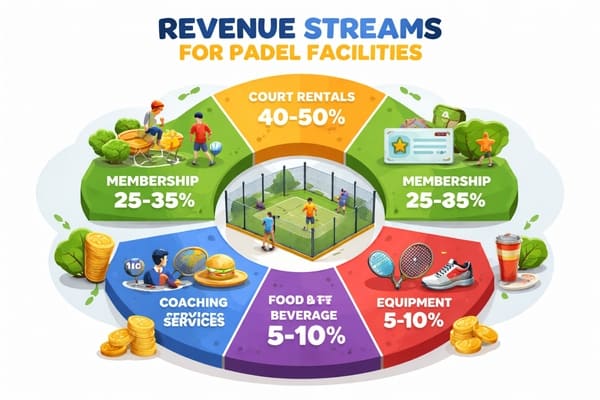
Diversified revenue streams create stable, recession-resistant business models. Here’s how successful facilities maximize profitability:
Comprehensive Revenue Model
| Revenue Stream | Percentage of Total | Monthly Revenue (4 courts) | Key Success Factors |
|---|---|---|---|
| Court Rentals | 40-50% | $8,000-15,000 | Dynamic pricing, peak optimization |
| Memberships | 25-35% | $5,000-10,000 | Tiered options, retention programs |
| Coaching/Clinics | 10-15% | $2,000-4,500 | Quality instructors, program variety |
| Equipment Sales | 5-10% | $1,000-3,000 | Exclusive brands, demo programs |
| F&B/Pro Shop | 5-10% | $1,000-2,500 | Convenience, quality selection |
| Total Revenue | 100% | $17,000-35,000 | Integrated strategy |
Court rental optimization requires sophisticated pricing strategy beyond simple hourly rates. Implement peak/off-peak pricing with 40-60% premium for evening and weekend slots. Early morning and weekday afternoon rates at 30-40% discount fill otherwise empty courts. Dynamic pricing using booking software adjusts rates based on demand patterns, weather, and advance booking timing.
Membership programs create recurring revenue and customer loyalty. Entry-level memberships at $50-80 monthly include off-peak court access and booking priority. Mid-tier options at $100-150 monthly add peak-hour credits and group lesson access. Premium memberships at $200-300 monthly provide unlimited play, guest privileges, and personal coaching sessions.
Coaching services generate high-margin revenue while improving member retention. Private lessons at $50-80 per hour create premium income with minimal overhead. Group clinics for 4-8 players at $25-35 per person achieve better instructor utilization. Structured programs like 8-week beginner courses at $250-400 per participant build predictable revenue streams.
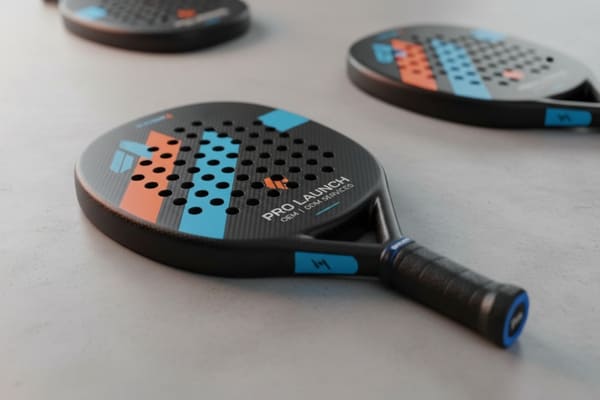
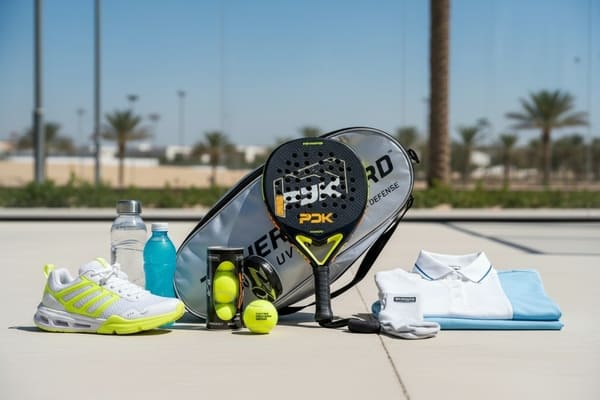
Equipment retail provides modest direct revenue but significant strategic value. Exclusive distribution partnerships with quality brands like PDK create differentiation and member convenience. Demo programs allowing members to test rackets before purchase drive sales while improving player experience. Consignment arrangements minimize inventory risk while maintaining product availability.
Tournament and event hosting opens additional revenue channels. Weekend tournaments at $40-80 entry fee per team fill courts during typically slower periods. Corporate team-building events at $500-1,500 per session attract business clients. League play with seasonal fees creates community engagement while generating steady income.
Food and beverage services require careful implementation based on facility size. Small clubs succeed with vending machines and coffee service requiring minimal investment. Larger facilities benefit from café operations generating 25-35% profit margins on sales. Partnership arrangements with local restaurants or catering companies provide service without operational complexity.
Sponsorship and advertising revenue grows as facility reputation develops. Local business sponsorships at $2,000-10,000 annually for court naming rights or tournament support. Equipment manufacturer partnerships providing subsidized gear in exchange for exclusivity. Digital advertising on booking platforms or facility websites generating passive income.
Conclusion
Padel represents a compelling investment opportunity for facility developers and equipment distributors, with courts costing $18,000-45,000 generating 15-25% annual returns through diversified revenue streams. Success requires proper market selection, quality construction, and comprehensive business models beyond simple court rentals to maximize profitability.
-
Discover the potential returns on investment for padel courts and how they compare to other sports facilities. ↩
-
Explore why location matters and how affluent urban areas can enhance the success of padel courts. ↩
-
Investigate how choosing the right market can significantly affect the success and returns of your padel court investment. ↩
-
Understand the financial implications of different revenue models for padel courts and which might suit your investment. ↩
-
Explore effective strategies to enhance court rental income, a key revenue stream for padel facilities. ↩
-
Discover best practices for coaching services that can enhance member retention and profitability. ↩
-
Find out how to implement successful food and beverage sales strategies to increase profits. ↩