What are heat-resistant cores in padel rackets?
You leave your racket in the car on a hot day. When you pick it up, the sweet spot feels off. The power drops. The core inside has started breaking down.
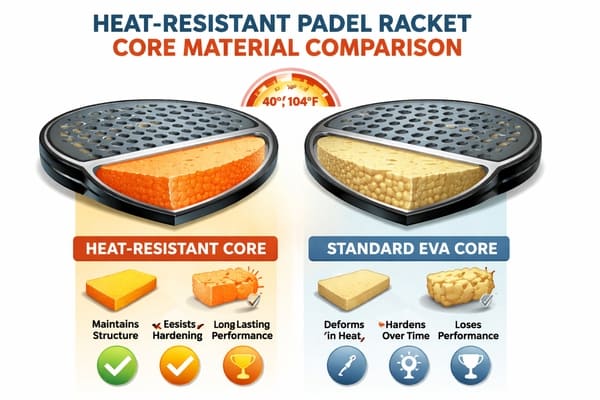
Heat-resistant cores are specially engineered foam materials designed to maintain their structure and performance even when exposed to high temperatures (above 40°C / 104°F). Unlike standard EVA foam, these cores resist deformation, hardening, and structural collapse caused by prolonged heat exposure.
At Padel Keeper, I’ve seen countless distributors return batches because rackets left in storage or retail displays warped in summer heat. That’s when we started investing heavily in thermal-stable core technology. Let me walk you through what makes these cores different and why they matter for your business.
Why Do Standard Padel Racket Cores Fail in High-Temperature Environments?
Heat breaks down foam faster than most people realize. Standard cores aren’t built for the temperatures rackets actually face in real-world conditions.
Standard EVA and FOAM cores soften, lose density, and develop micro-cracks when exposed to temperatures above 40°C for extended periods. This happens because the polymer chains inside the foam begin to break down, causing permanent changes to the material’s cellular structure.
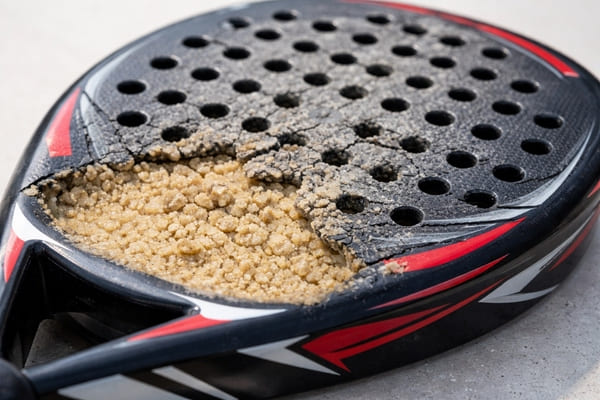
I remember a distributor from Spain who stored 500 rackets in a warehouse without climate control. After one summer, 30% of the batch showed visible deformation. The cores had compressed unevenly. The rackets felt dead when players tested them. That loss wasn’t just inventory—it damaged his brand reputation with local clubs.
Standard cores fail because of three main factors. First, the base polymer isn’t stabilized against thermal stress. Most manufacturers use basic EVA compounds optimized for cost, not temperature resistance. Second, the foam density drops as heat causes the cells to expand and collapse irregularly. Third, the bonding agents that hold the foam structure together weaken rapidly above certain thresholds.
| Temperature Range | Effect on Standard EVA Core | Effect on Heat-Resistant Core |
|---|---|---|
| Below 30°C (86°F) | Normal performance | Normal performance |
| 30-40°C (86-104°F) | Slight softening begins | Maintains full structure |
| 40-50°C (104-122°F) | Noticeable deformation | Minor softening only |
| Above 50°C (122°F) | Permanent structural damage | Engineered thermal tolerance |
Think about where rackets actually sit. In car trunks during summer, temperatures easily hit 60°C (140°F). On retail shelves near windows, direct sunlight pushes surface temps even higher. Standard cores weren’t designed for these conditions. They were designed for controlled indoor storage and immediate use. The gap between design assumptions and reality causes most heat-related failures.
Heat-Resistant Cores vs. Standard EVA: What’s the Difference?
The materials look similar on the surface. But the chemistry and manufacturing process create completely different performance profiles under stress.
Heat-resistant cores use modified polymer compounds with enhanced cross-linking and thermal stabilizers. These materials maintain their cellular structure up to 60°C (140°F), while standard EVA cores begin degrading at 40°C (104°F). The result is consistent density, rebound properties, and durability across a much wider temperature range.
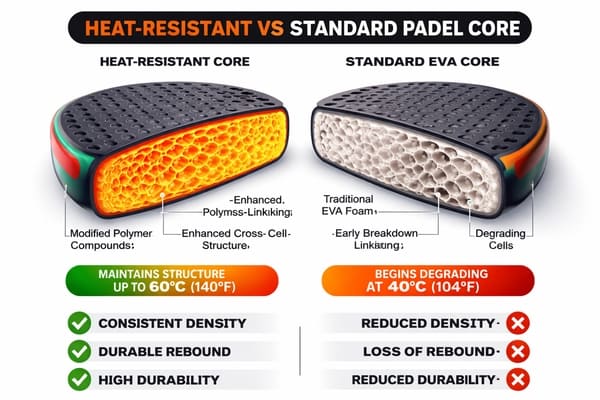
At our facility, we run accelerated aging tests on every core batch. We cycle rackets through 48-hour periods at 55°C, then measure hardness and rebound coefficient. Standard EVA loses 15-20% of its rebound after just one cycle. Our heat-resistant cores show less than 3% variance even after five cycles.
The manufacturing process makes the biggest difference. Standard EVA gets mixed, molded, and cured in basic batch processes. Heat-resistant cores require additional steps. We add thermal stabilizers during the polymer mixing phase. These are chemical compounds that strengthen the molecular bonds. Then we use a multi-stage curing process with precise temperature control. This creates a more uniform cell structure throughout the foam.
The physical properties shift dramatically. Standard cores typically measure 20-25 on the Shore C hardness scale. When heated, they can drop to 15-18, making the racket feel mushy. Heat-resistant cores maintain 22-24 across the entire temperature range. Players feel this as consistent power and control, regardless of storage conditions.
| Property | Standard EVA Core | Heat-Resistant Core |
|---|---|---|
| Base Material | Basic EVA polymer | Modified EVA with stabilizers |
| Max Operating Temp | 40°C (104°F) | 60°C (140°F) |
| Density Retention (after heat) | 75-80% | 95-98% |
| Cost Premium | Baseline | +15-25% |
| Typical Lifespan | 1-2 years | 2-4 years |
I source materials from three different suppliers. Only one consistently delivers the thermal stability we need. The difference shows up in our warranty return rates. For standard core models, we see 8-12% returns due to heat-related issues. For heat-resistant models, that drops to under 2%. That’s real data from the past three years of European distribution.
Can a Heat-Resistant Core Extend Your Racket’s Lifespan?
Longer lifespan isn’t just marketing talk. The numbers back it up when you compare identical rackets with different core materials over time.
Heat-resistant cores typically extend functional racket life by 40-60% compared to standard cores in regions with hot climates or inconsistent storage conditions. This translates to an additional 6-12 months of peak performance for recreational players and consistent playability for inventory sitting in warehouses or retail environments.
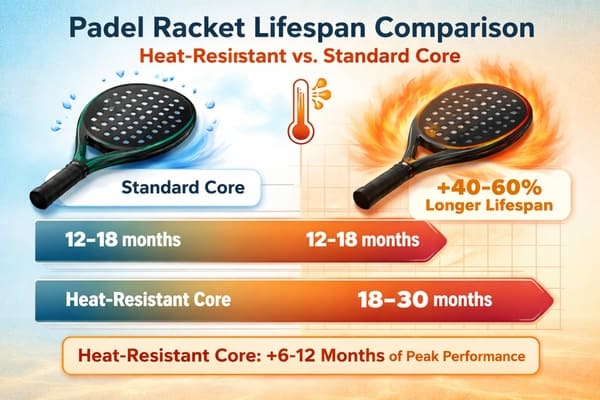
One of my largest distributors in Italy runs rental programs at beach clubs. They originally used standard core rackets. Average usable life was 14 months before the cores felt too soft. We switched them to heat-resistant models two seasons ago. Those same rackets are still in rotation after 22 months, with only the grip tape and frame edges showing wear.
The extended lifespan comes from preventing the cascade of failures that heat triggers. When a core starts breaking down, it doesn’t just lose bounce. The uneven density creates stress points where the core meets the frame. These stress points cause delamination—the face separates from the core. Once delamination starts, the racket is finished within weeks.
Heat-resistant cores maintain uniform density. This keeps the bonding surface stable. The adhesive layers don’t experience the expansion and contraction cycles that cause separation. I’ve cut open rackets after 24 months of heavy use. Standard cores show visible gaps and air pockets between layers. Heat-resistant cores look nearly identical to new production.
| Usage Scenario | Standard Core Lifespan | Heat-Resistant Core Lifespan | Improvement |
|---|---|---|---|
| Club rental program | 12-15 months | 20-24 months | +67% |
| Retail inventory (summer) | 18 months (before stock degrades) | 36+ months (minimal degradation) | +100% |
| Casual player (outdoor storage) | 18-24 months | 30-36 months | +50% |
| Competitive player (proper storage) | 24-30 months | 30-40 months | +25% |
The cost analysis matters here. Heat-resistant cores add 15-25% to manufacturing cost. But if the racket lasts 50% longer, the cost per playing hour drops significantly. For distributors, this means fewer warranty claims and higher customer satisfaction. For rental operations, it directly impacts replacement budgets.
I track warranty data across all our distribution channels. Standard core rackets show a sharp spike in returns between months 14-18. That’s when heat damage accumulates to the point where players notice. Heat-resistant cores show a much flatter curve. Returns stay low until month 24-28, and even then, they’re usually from impact damage or grip wear, not core degradation.
One detail I learned the hard way: heat-resistant doesn’t mean indestructible. These cores still need basic care. Don’t leave rackets in direct sunlight for hours. Don’t store them pressed against hot metal surfaces. The cores handle ambient heat and normal storage conditions far better than standard materials, but extreme abuse will still cause problems. The difference is the margin of safety. Standard cores have almost no buffer. Heat-resistant cores give you room for the real-world mistakes that happen in busy distribution chains and retail environments.
Conclusion
Heat-resistant cores solve a real problem that standard materials can’t handle. They give your inventory and your customers’ rackets the durability that hot climates and imperfect storage demand.