Padel Racket Technology: Core Materials and Face Structures Explained
You pick up two rackets that look identical. Same shape. Same weight. But one feels responsive and controlled. The other feels dead and unpredictable.
The performance difference in padel rackets comes from two hidden components: the core material (typically EVA foam with varying densities) and the face structure (carbon fiber, fiberglass, or hybrid layers). These materials determine power generation, ball control, vibration dampening, and durability—accounting for 70-80% of how a racket actually plays.
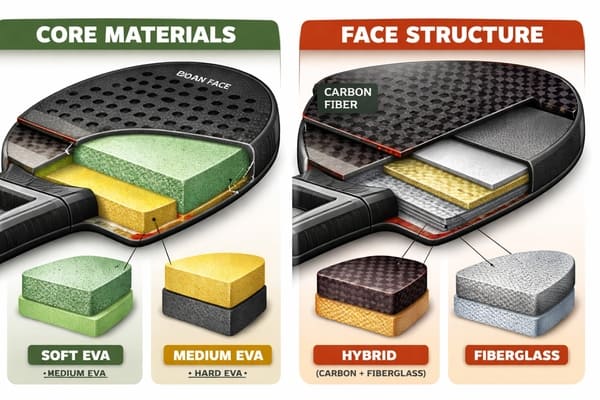
At Padel Keeper, I spend half my time explaining why identical-looking rackets perform completely differently. The materials you can’t see matter more than the graphics you can. Let me break down exactly how core materials and face structures work, and why understanding them helps you choose better equipment.
Understanding Core Materials: EVA Density, Foam Types, and Their Performance Impact
The core sits in the middle of every racket. You never see it. But it controls how energy transfers from your swing to the ball.
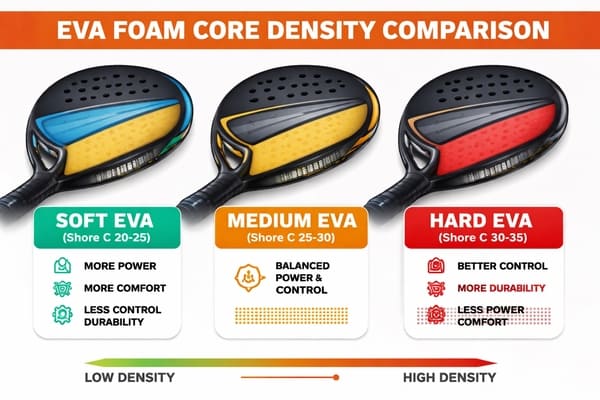
EVA (Ethylene-Vinyl Acetate) foam cores1 come in different densities measured in Shore hardness2, typically ranging from 20 to 35 on the Shore C scale. Lower density (softer) cores provide more power and comfort but less control and durability. Higher density (harder) cores deliver better control and longevity but require more player strength and offer less vibration absorption.
I test every core batch we receive. A distributor once asked why his customers complained that rackets felt "mushy" after three months. When I checked, his supplier had used 18 Shore hardness2 foam—too soft for consistent performance. The foam compressed permanently after repeated impacts. Players lost power and control as the core degraded.
EVA foam works through cellular structure3. The foam contains millions of tiny air bubbles trapped in the polymer matrix. When you hit the ball, these cells compress and release, storing and returning energy. Density determines how much the cells compress and how quickly they return to original shape.
Soft EVA cores (20-24 Shore C hardness) compress easily. This creates a longer contact time between ball and racket—the ball "sinks" into the surface slightly. Longer contact time generates more power because the racket transfers more energy to the ball. Players feel this as a comfortable, forgiving response. The downside: soft cores wear faster. The cells don’t fully recover after each impact. Over 6-12 months, the core loses rebound properties and feels progressively deader.
Hard EVA cores (28-35 Shore C hardness) compress less. Contact time shortens. The ball leaves the racket faster with less energy transfer. This requires more player effort to generate power but provides better control because ball placement depends more on swing mechanics than core compression. Hard cores last longer—the cells maintain structure through thousands of impacts.
| Core Density (Shore C) | Feel Characteristic | Power Level | Control Level | Durability | Best For |
|---|---|---|---|---|---|
| 20-22 (Very Soft) | Maximum comfort | Very High | Low | 6-12 months | Beginners, recreational players |
| 23-25 (Soft) | Comfortable, forgiving | High | Medium | 12-18 months | Intermediate players, all-court style |
| 26-28 (Medium) | Balanced response | Medium | High | 18-24 months | Advanced players, balanced game |
| 29-31 (Hard) | Firm, direct feedback | Low | Very High | 24-30 months | Competitive players, control-oriented |
| 32-35 (Very Hard) | Maximum feedback | Very Low | Maximum | 30+ months | Professional players, defensive style |
Beyond basic EVA density, foam type matters. Standard EVA uses a single-density structure throughout the core. Multi-density EVA combines different hardness zones—softer near the sweet spot for power, harder toward edges for stability. We use multi-density construction in our premium models. It costs 20% more to manufacture but delivers performance characteristics that single-density cores can’t match.
FOAM (a polyethylene-based material)4 represents an alternative to EVA. FOAM cores feel softer at equivalent densities and maintain that soft feel longer because the polymer structure recovers better from compression. The downside: FOAM costs 40-60% more than EVA and requires different manufacturing processes. We offer FOAM cores for clients targeting premium market segments where players prioritize comfort over cost.
Memory foam technology5 has entered padel racket cores recently. This material adapts to playing style over time—the foam "remembers" frequent impact zones and adjusts its compression characteristics. The technology sounds impressive, but I’ve tested it extensively. Real-world performance gains are minimal for most players. The cost premium (60-80% over standard EVA) doesn’t justify the marginal improvement unless you’re manufacturing for professional players who can detect subtle differences.
Core thickness impacts performance as much as density. Standard cores measure 36-38mm thick. Thicker cores (40-42mm) provide more power because they store more energy during compression. Thinner cores (34-36mm) give better control because less material compresses. At Padel Keeper, we adjust core thickness based on target player level. Beginner-focused models use 38-40mm for maximum power assistance. Advanced models use 36-37mm for precise control.
One detail many manufacturers ignore: core-edge treatment. The foam edges where core meets frame experience the highest stress. Untreated edges compress and crack, causing delamination between core and face. We apply edge-reinforcement treatment6—a resin coating that stabilizes the foam structure at edges. This adds $1.50 per racket in manufacturing cost but reduces delamination failures7 by 80%.
Exploring Face Structures: Carbon Fiber, Fiberglass, and Hybrid Layer Combinations
The face transfers force from your arm to the core and from the core to the ball. Face material determines how efficiently this transfer happens and how long the racket survives.
Carbon fiber faces8 provide maximum stiffness and power transmission but cost 3-5 times more than fiberglass. Fiberglass faces9 offer better vibration dampening10 and forgiveness at lower cost. Hybrid structures11 combine both materials in strategic layer arrangements to balance performance characteristics and manufacturing costs, typically using carbon fiber for outer layers (stiffness) and fiberglass for inner layers (comfort).
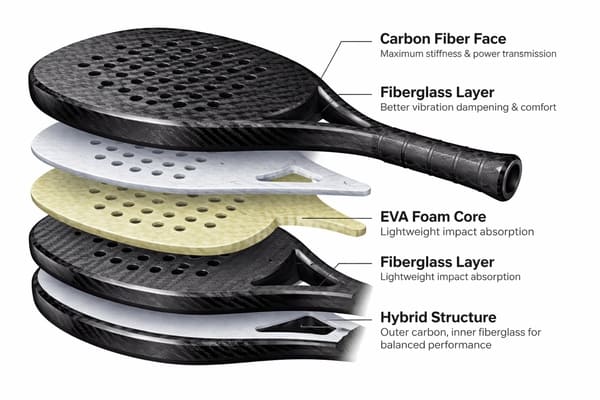
I remember a client who insisted on full carbon fiber construction for a beginner-level racket. He thought it would sell better with "100% carbon" marketing. The rackets came out too stiff. Beginners complained about arm vibration and lack of feel. We redesigned with a hybrid structure—two carbon layers outside, one fiberglass layer inside. Same visual appearance, but completely different performance.
Carbon fiber works through high tensile strength and low weight. The material resists deformation, meaning energy doesn’t get lost in face flex. When you hit the ball, almost all your swing energy transfers through the stiff face into the core and then to the ball. This creates powerful, direct response. Players feel immediate feedback. The ball leaves fast.
The downside of carbon stiffness: vibration. When the ball impacts, carbon fiber transmits shock waves through the frame into your arm. Over extended play sessions, this causes discomfort or pain. Professional players with excellent technique can handle this. Recreational players often can’t. That’s why pure carbon fiber rackets work best for advanced players with proper stroke mechanics.
Carbon fiber quality varies dramatically. We source three grades. Basic 3K carbon (3,000 filaments per strand) costs $12 per square meter. Mid-grade 6K carbon costs $22 per square meter. Premium 12K carbon costs $38 per square meter. The difference shows up in stiffness consistency12 and durability. Basic carbon develops micro-cracks after 500-800 playing hours. Premium carbon maintains structure through 1,500+ hours.
Fiberglass faces9 flex more than carbon. This flex absorbs impact energy, reducing vibration transmission to the player’s arm. Players describe fiberglass rackets as "comfortable" or "forgiving." The tradeoff: some energy gets lost in face flex instead of transferring to the ball. This reduces power output compared to carbon fiber of equal weight.
| Face Material | Stiffness Rating | Power Transfer | Vibration | Durability | Cost Per m² | Best For |
|---|---|---|---|---|---|---|
| Pure Fiberglass | Low | 70-75% | Very Low | Medium | $6-8 | Beginners, comfort-seekers |
| Fiberglass + 1 Carbon Layer | Medium-Low | 75-80% | Low | Medium-High | $14-18 | Recreational players |
| 2 Carbon + 1 Fiberglass (Hybrid) | Medium | 82-87% | Medium | High | $22-28 | Intermediate to advanced |
| Pure 3K Carbon Fiber | High | 88-92% | High | High | $32-38 | Advanced players |
| Premium 12K Carbon Fiber | Very High | 92-96% | Very High | Very High | $55-65 | Professional players |
Hybrid constructions give us the most design flexibility. We can place carbon fiber where stiffness matters most and fiberglass where comfort matters most. A typical hybrid structure uses carbon fiber on the outer layers (closest to the ball) for stiff response, with fiberglass in the middle layer for vibration dampening10. This creates 85-90% of carbon’s power transfer with significantly better comfort.
Layer orientation matters as much as material type. Carbon fiber has directional strength—it’s strongest along the fiber direction. We orient outer carbon layers at 0° and 90° to the racket’s longitudinal axis. This maximizes stiffness in hitting direction while maintaining frame stability. Inner layers run at 45° angles to handle torsional (twisting) forces. Getting these angles right requires experience. Wrong orientation creates rackets that feel unstable or develop stress cracks.
Resin system holds fiber layers together. We use two types: polyester resin costs $4 per kilogram and provides adequate bonding for recreational rackets. Epoxy resin costs $12 per kilogram but creates 40% stronger bonds and resists delamination better. For rackets targeting serious players or harsh climates, epoxy resin is essential despite the cost increase.
Face thickness varies from 1.5mm to 3.0mm across different models. Thinner faces (1.5-2.0mm) flex more, providing comfort but less durability. Thicker faces (2.5-3.0mm) last longer but feel stiffer. We specify 2.2-2.5mm for most models—a practical balance between performance and longevity.
Surface texture affects spin generation. Rough surfaces (created through sandblasting or textured molds) grab the ball better, allowing players to impart more spin. Smooth surfaces create less friction, generating more pace but less spin. At Padel Keeper, we offer three texture options: smooth for power players, medium texture for all-court players, and aggressive texture for spin-oriented players.
One manufacturing detail that matters: the number of face layers. Entry-level rackets use 2-3 layers total. Mid-range models use 4-5 layers. Premium rackets use 6-8 layers. More layers don’t automatically mean better—it’s about strategic placement. We use eight-layer construction in top models: two outer carbon layers for stiffness, two fiberglass layers for dampening, two more carbon layers for strength, and two thin aramid layers for impact resistance.
How Core and Face Interactions Influence Power, Control, and Durability
Core and face don’t work independently. They form a system where each component affects the other’s performance. Understanding this interaction explains why identical materials can produce different results.
The core-face interface13 determines energy transfer efficiency14, vibration patterns15, and structural durability16. Soft cores paired with stiff faces create powerful rackets with excellent durability but increased arm vibration. Hard cores paired with flexible faces provide maximum comfort but reduced power and faster face fatigue. Optimal combinations match core density17 to face stiffness, creating balanced performance characteristics that suit specific player types and playing styles.
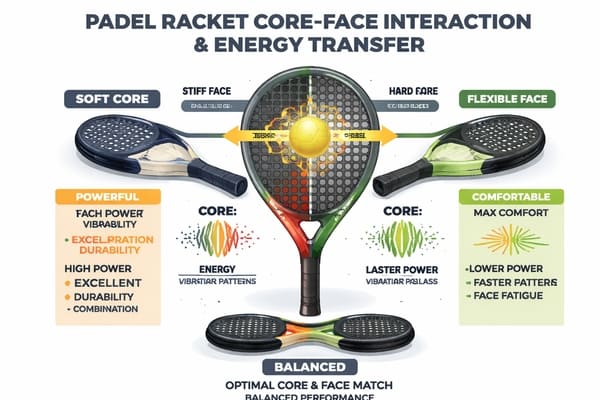
I learned about core-face interaction the hard way. We designed a racket with premium 12K carbon face and very soft EVA core (22 Shore C). On paper, it should have been powerful and comfortable. In testing, it failed within 20 hours of play. The stiff face transmitted so much impact force that the soft core compressed permanently. Within weeks, the core developed internal cracks. The mismatch between materials created structural failure.
Energy transfer happens in milliseconds. Ball impacts face. Face compresses slightly and transfers force to core. Core compresses and stores energy. Core rebounds, pushing face outward. Face accelerates ball away from racket. This cycle takes 3-6 milliseconds. The efficiency of each step determines overall racket performance.
When face stiffness matches core hardness, energy flows smoothly through the system. A hard core (30 Shore C) works well with stiff carbon face because both materials compress minimally and rebound quickly. A soft core (23 Shore C) pairs better with flexible fiberglass face because both materials compress more and rebound more slowly. These matched systems feel "smooth" to players—energy transfer happens predictably.
Mismatched systems create problems. Stiff face with soft core: the face doesn’t compress much, dumping all impact force into the core. The core compresses excessively, losing energy and wearing faster. Players feel this as reduced power over time. Flexible face with hard core: the face compresses significantly while the core barely moves. Energy gets lost in face flex. Players feel reduced responsiveness.
| Core Type | Face Type | Power | Control | Comfort | Durability | Sweet Spot Size | Best For |
|---|---|---|---|---|---|---|---|
| Soft EVA | Fiberglass | Very High | Low | Very High | Low | Large | Beginners, casual play |
| Soft EVA | Hybrid | High | Medium | High | Medium | Medium-Large | Recreational players |
| Soft EVA | Carbon | High | Medium-High | Low | Low | Medium | Power-oriented intermediate |
| Medium EVA | Fiberglass | Medium | Medium | High | Medium-High | Medium | All-around recreational |
| Medium EVA | Hybrid | Medium | High | Medium | High | Medium | Competitive all-court |
| Medium EVA | Carbon | Medium-High | Very High | Low-Medium | High | Small-Medium | Advanced control players |
| Hard EVA | Hybrid | Low-Medium | Very High | Medium | Very High | Small | Defensive specialists |
| Hard EVA | Carbon | Low | Maximum | Low | Very High | Small | Professional players |
Adhesive bonding between core and face critically impacts durability. We use three bonding methods18. Contact adhesive (applied to both surfaces, pressed together) costs $0.30 per racket and works for entry-level models. Structural adhesive (two-part epoxy system) costs $1.20 per racket and provides bonds strong enough for competitive use. Hot-melt adhesive (applied molten, cures as it cools) costs $0.80 per racket and offers good performance for mid-range models.
Bonding failure causes delamination19—the face separates from core. This happens when stresses exceed adhesive strength. Stiff face with soft core creates high stress at the bond line because the materials compress at different rates. This stress concentrates at edges and near the sweet spot. Without proper adhesive selection and edge reinforcement, these stress zones cause delamination19 within 6-12 months.
Sweet spot size results from core-face interaction. When you hit the ball in the center, both core and face compress evenly. The energy transfer is efficient. Hit off-center, and the face bends more on one side while the core compresses unevenly. This asymmetric compression wastes energy and creates vibration. Larger sweet spots come from either softer cores (which compress more evenly across a wider area) or thicker faces (which distribute force over larger areas).
At Padel Keeper, we measure sweet spot scientifically. We impact test at 20 points across the face, measuring rebound velocity at each point. The sweet spot includes all points where rebound velocity stays within 5% of maximum. Soft core + fiberglass face rackets show sweet spots covering 45-55% of face area. Hard core + carbon face rackets show sweet spots of only 25-35% of face area.
Weight distribution affects core-face interaction. Heavy faces (using thick carbon layers) create head-heavy balance. This increases swing weight, generating more power through momentum but reducing maneuverability. Light faces create head-light balance, improving control and quick reactions but reducing power. We adjust core density17 to compensate—use softer cores with heavy faces to maintain power, harder cores with light faces to maintain control.
Temperature changes impact core-face systems dramatically. Heat softens EVA cores and reduces face stiffness. A racket that feels
-
Explore the advantages of EVA foam cores to understand their impact on performance and comfort in sports gear. ↩
-
Learn about Shore hardness measurement to better understand material properties and their applications in various industries. ↩ ↩
-
Discover how cellular structures influence the performance of materials, especially in sports equipment. ↩
-
Investigate the unique properties of FOAM and its advantages over traditional materials in sports gear. ↩
-
Understand the mechanics of memory foam technology and its potential benefits for athletes. ↩
-
Learn about edge-reinforcement treatment and its role in enhancing the durability of rackets. ↩
-
Discover the causes of delamination failures and effective prevention methods to ensure equipment longevity. ↩
-
Explore the advantages of carbon fiber faces for enhanced performance and durability in sports gear. ↩
-
Learn how fiberglass faces provide comfort and vibration dampening for a better playing experience. ↩ ↩
-
Understand the significance of vibration dampening in enhancing player comfort and reducing injury risk. ↩ ↩
-
Discover how hybrid structures combine materials for optimal performance and comfort in rackets. ↩
-
Find out why stiffness consistency is crucial for maximizing energy transfer and performance in rackets. ↩
-
Understanding the core-face interface is crucial for optimizing racket performance and enhancing player experience. ↩
-
Exploring energy transfer efficiency can help players choose the right racket for their playing style. ↩
-
Understanding vibration patterns can enhance comfort and control during play. ↩
-
Learn about structural durability to ensure your equipment lasts longer and performs better. ↩
-
Exploring core density can guide players in choosing the right racket for their skill level. ↩ ↩
-
Discovering bonding methods can provide insights into the quality and longevity of your sports gear. ↩
-
Understanding delamination can help players avoid equipment failures and enhance their game. ↩ ↩