Padel Racket Materials Explained: Carbon Fiber vs Fiberglass
Distributors face constant questions about material differences but lack clear technical knowledge to guide buying decisions. They risk choosing wrong materials for their customer segments, leading to returns, complaints, and lost sales opportunities.
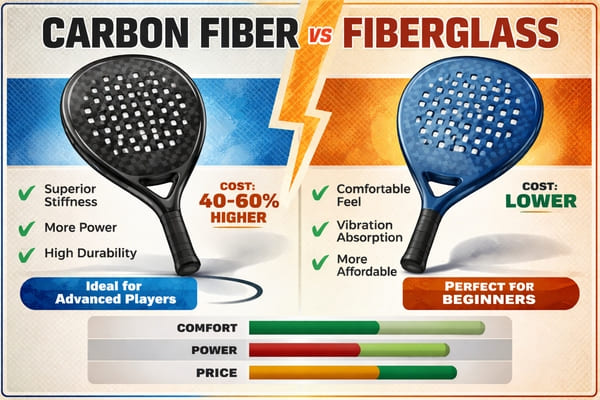
Carbon fiber padel rackets offer superior stiffness, power, and durability at 40-60% higher cost, ideal for advanced players. Fiberglass rackets provide comfort, vibration absorption, and affordability, perfect for beginners and recreational players. Material choice directly impacts customer satisfaction, return rates, and profit margins across different market segments.
At PDK, I guide distributors through material selection conversations weekly. The buyers who understand material properties and match them to customer profiles consistently achieve better sales velocity and lower return rates than those choosing materials based solely on price.
What Are the Key Differences Between Carbon Fiber and Fiberglass Padel Rackets?
Many distributors treat material selection as a simple price decision without understanding how construction fundamentally affects racket behavior. This oversimplification causes mismatches between products and customer needs.
Carbon fiber rackets use woven carbon strands in epoxy resin, creating stiff, lightweight structures that transfer energy efficiently with minimal flex. Fiberglass rackets employ glass fiber fabric in polymer matrix, producing flexible, shock-absorbing frames that reduce vibration and forgive off-center hits. The materials differ dramatically in stiffness (3x), weight (15-20%), cost (40-60%), and player feel.
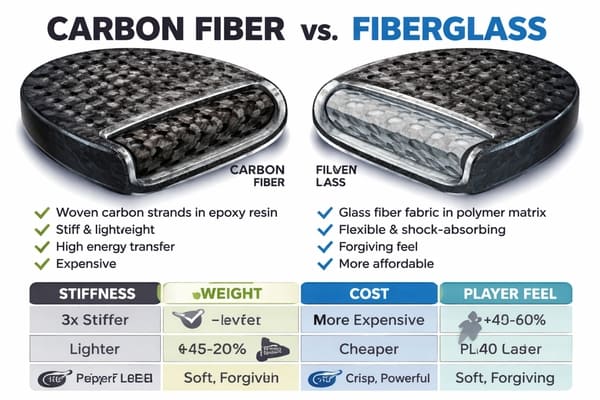
Understanding material science helps explain performance differences players experience. Here’s the detailed comparison:
Material Property Comparison
| Property | Carbon Fiber | Fiberglass | Impact on Performance |
|---|---|---|---|
| Stiffness (GPa) | 230-240 | 70-80 | Power generation |
| Density (g/cm³) | 1.75-1.80 | 2.50-2.60 | Overall weight |
| Tensile Strength (MPa) | 3,500-4,500 | 1,500-2,000 | Durability |
| Vibration Damping | Low (15-20%) | High (40-50%) | Comfort level |
| Cost per kg | $25-35 | $8-12 | Retail price |
| Manufacturing Complexity | High | Medium | Production cost |
Carbon fiber’s molecular structure creates its performance advantages. Carbon atoms bond in crystalline formation along fiber length, producing exceptional stiffness in the fiber direction. When we weave carbon into fabric and laminate multiple layers, the racket frame resists bending under ball impact. This stiffness translates directly to power—less energy absorbs into frame flex means more energy transfers to the ball.
The stiffness advantage comes with tradeoffs players feel immediately. Carbon rackets provide crisp, direct feedback on every shot. Advanced players appreciate this tactile response for precise shot control. However, beginners find carbon rackets harsh and unforgiving. Off-center hits send uncomfortable vibrations through the handle, causing arm fatigue and potential injury over extended play.
Fiberglass construction uses completely different mechanical properties. Glass fibers embedded in polymer matrix create composite materials that flex under load then return to original shape. This flexibility acts like suspension in a car—absorbing shock before it reaches the player’s arm. At PDK, we use E-glass fibers (electrical grade glass) rather than cheaper variants because they provide better strength-to-weight ratios.
The fiber weave pattern significantly affects final racket behavior. Plain weave patterns alternate over-under in both directions, creating balanced properties but slightly rough surface texture. Twill weaves pass over two fibers before going under, producing smoother surfaces and easier resin impregnation. We use twill weaves for visible racket faces because they look better while maintaining performance.
Layer count1 and orientation determine final racket stiffness and weight. A basic fiberglass racket uses 3-4 layers of woven fabric with fibers oriented at 0° and 90° angles. Each layer adds 40-50 grams to total weight. Carbon rackets achieve equivalent strength with 2-3 layers due to superior material properties, saving 60-80 grams overall weight.
Resin systems2 differ between carbon and fiberglass applications. Carbon fiber requires high-temperature curing epoxy resins that fully harden at 120-140°C. This creates maximum stiffness but demands precise temperature control during manufacturing. Fiberglass works with lower-temperature polyester or vinyl ester resins curing at 60-80°C. The different resin systems affect both manufacturing costs and final product properties.
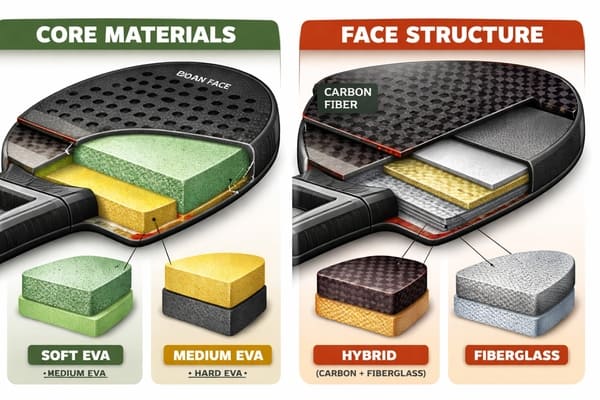
Core material interaction with face materials creates the complete performance package. Carbon faces paired with EVA foam cores produce very stiff, powerful rackets. Fiberglass faces with soft foam cores create flexible, comfortable options. At PDK, we also produce hybrid constructions—carbon outer layers for stiffness with fiberglass inner layers for vibration damping. These hybrids bridge the performance gap between pure materials.
Manufacturing precision requirements differ substantially. Carbon fiber layup demands exact fiber orientation within 2-3 degrees and consistent resin content at 35-40% by weight. Small variations cause performance inconsistencies players immediately notice. Fiberglass tolerates 5-7 degree orientation variations and 30-45% resin content ranges while maintaining acceptable performance. This tolerance difference affects production costs and quality consistency.
Which Material Is Better for Performance, Durability, and Player Level?
Distributors need clear guidance matching materials to customer segments rather than vague claims about quality differences. Without objective criteria, they struggle to position products effectively and lose sales to competitors with clearer messaging.
Carbon fiber excels for advanced and professional players prioritizing power, precision, and competitive performance, offering 300+ hour durability and maintaining stiffness over time. Fiberglass suits beginners and recreational players needing comfort, forgiveness, and injury prevention, with 200-250 hour durability and gradual softening that actually improves feel for casual use.
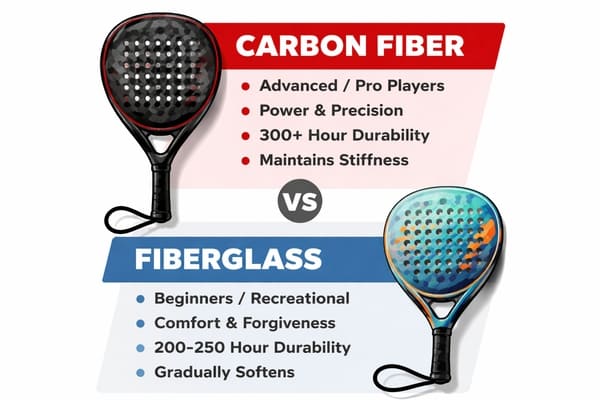
Matching materials to player profiles requires understanding both technical properties and practical usage patterns. Here’s the complete analysis:
Performance Comparison by Player Level
-
Beginner Players (0-6 months):
- Recommended material: Fiberglass or fiberglass hybrid
- Key benefit: Vibration absorption reduces arm strain
- Performance priority: Comfort over power
- Typical playing frequency: 1-2 times per week
- Shot consistency: High error rate on contact point
- Budget sensitivity: High (prefer $60-100 range)
- Durability requirement: 150-200 hours sufficient
-
Intermediate Players (6-24 months):
- Recommended material: Hybrid construction or entry carbon
- Key benefit: Balance between comfort and performance
- Performance priority: Improving power while maintaining comfort
- Typical playing frequency: 2-3 times per week
- Shot consistency: Improving but still variable
- Budget range: Moderate ($100-180)
- Durability requirement: 200-300 hours needed
-
Advanced Players (2+ years):
- Recommended material: High-quality carbon fiber
- Key benefit: Maximum power and control precision
- Performance priority: Performance over comfort
- Typical playing frequency: 3-5 times per week
- Shot consistency: High accuracy on contact point
- Budget acceptance: Higher ($180-350)
- Durability requirement: 300+ hours expected
Power generation3 differs by 20-30% between materials with identical player swing speeds. In our testing at PDK, advanced players using carbon rackets generate ball speeds of 110-120 km/h on groundstrokes versus 85-95 km/h with fiberglass rackets. This difference comes entirely from energy transfer efficiency. The stiffer carbon frame wastes less energy flexing, directing more force into ball acceleration.
However, this power advantage matters only if players consistently hit the sweet spot. Beginners contact balls 3-5cm off-center on 40-50% of shots. On these mis-hits, fiberglass rackets maintain 70-80% of optimal power while carbon drops to 50-60%. The fiberglass flexibility helps redirect off-center impacts toward intended direction, effectively expanding the usable hitting area.
Control precision4 depends on frame feedback and consistency. Carbon fiber’s stiffness provides identical response on every shot when players strike the sweet spot correctly. Advanced players develop muscle memory for exact contact points, benefiting from this predictability. Fiberglass rackets feel slightly different depending on exact impact location due to frame flex, making precision harder for skilled players to develop.
Vibration transmission directly affects injury risk and playing comfort. Carbon rackets transmit 60-70% of impact vibration to the player’s arm compared to 30-40% for fiberglass. This difference accumulates over playing sessions. After 2-3 hour matches, fiberglass users report significantly less arm fatigue and soreness. For players over 40 or those with existing elbow issues, this comfort difference becomes critical for continued participation.
Durability manifests differently across materials. Carbon fiber maintains stiffness and performance characteristics for 300-400 playing hours before showing degradation. The material doesn’t soften—it maintains properties until structural failure occurs. Fiberglass gradually softens over 200-250 hours as resin matrix develops microfractures. This softening actually improves comfort for recreational players, though it reduces power for competitive players.
Weather resistance5 varies substantially. Carbon fiber’s epoxy resin system resists moisture absorption effectively. Rackets maintain consistent weight and stiffness across 10-35°C temperature ranges and 30-80% humidity conditions. Fiberglass with polyester resin absorbs 0.5-1.5% moisture weight over time, slightly softening the frame and adding 5-10 grams. In hot climates above 35°C, some lower-quality fiberglass rackets show accelerated resin degradation.
Impact damage patterns6 differ between materials. Carbon fiber resists small impacts well but catastrophic failures occur without warning when stress exceeds material limits. Frame cracks propagate rapidly through carbon layers, often rendering rackets unusable. Fiberglass shows progressive damage—small cracks and delamination visible before complete failure. Players can often continue using damaged fiberglass rackets temporarily, while carbon failures happen suddenly during play.
How Should Buyers Choose the Right Material for Their Target Market?
Most distributors stock materials based on supplier recommendations or competitor copying without analyzing their specific customer demographics. This generic approach misses profit optimization opportunities from strategic material portfolio allocation.
Buyers should choose materials based on customer skill distribution (60% beginners prefer fiberglass, 40% advanced prefer carbon), price sensitivity (fiberglass suits budget-conscious markets, carbon targets premium segments), climate conditions7 (hot/humid climates favor carbon durability), and playing frequency (casual players accept fiberglass limitations, serious players demand carbon performance).
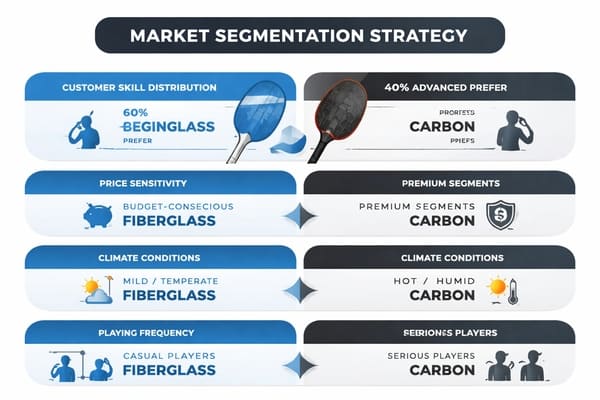
Strategic material selection requires analyzing multiple market factors simultaneously. Here’s the decision framework:
Material Selection Decision Matrix
| Market Factor | Fiberglass Focus (60-70%) | Balanced Portfolio (50-50%) | Carbon Focus (60-70%) |
|---|---|---|---|
| Average Player Skill | Mostly beginners | Mixed skill levels | Predominantly advanced |
| Price Sensitivity | High (budget priority) | Moderate | Low (performance priority) |
| Playing Frequency | 1-2x per week | 2-3x per week | 4+ times per week |
| Climate Conditions | Mild/moderate | Variable | Hot/humid |
| Market Maturity | Emerging (1-3 years) | Growing (3-7 years) | Mature (7+ years) |
| Competition Level | Recreational focus | Club leagues | Tournament circuits |
Market maturity dramatically affects optimal material mix. Emerging padel markets with 1-3 years of established play consist primarily of beginners trying the sport. These markets need 65-75% fiberglass inventory to match player profiles. Distributors entering emerging markets with carbon-heavy portfolios face slow inventory turns and price resistance. At PDK, we help new-market distributors start with affordable fiberglass lines then gradually introduce carbon options as player skills develop.
Growing markets (3-7 years established) show the most diverse player populations. Early adopters have advanced to intermediate or expert levels while continuous new player influx maintains strong beginner populations. These markets support balanced 45-55% material splits. Distributors in growing markets maximize revenue by offering clear upgrade paths—beginners start with fiberglass, then progress to hybrid constructions, finally moving to carbon as skills advance.
Mature markets with 7+ years of padel culture show inverted distributions—60-70% intermediate-to-advanced players with smaller beginner percentages. Spain, Argentina, and Sweden demonstrate this pattern. Mature market distributors optimize profits through carbon-focused portfolios with premium pricing. However, they still need entry-level fiberglass options because new players continuously enter even mature markets.
Price sensitivity analysis requires understanding local economic conditions and sports equipment spending patterns. Markets where average racket budgets stay below $120 need fiberglass-heavy portfolios. Premium markets accepting $180-300 rackets support carbon dominance. At PDK, we produce identical designs in both materials at different price points, letting distributors serve multiple segments without managing completely different product lines.
Climate conditions affect durability and performance consistency. Hot, humid coastal regions accelerate fiberglass degradation through moisture absorption and UV exposure. Carbon fiber’s superior weather resistance makes it the better choice despite higher initial cost. Customers in these climates actually save money over time through longer carbon racket lifespans. Conversely, mild indoor-focused markets don’t benefit from carbon’s weather advantages, making fiberglass cost savings more attractive.
Playing frequency directly correlates with material preference intensity. Players using rackets 1-2 times weekly for 1-2 hour sessions (total 2-4 hours weekly) don’t stress equipment enough to notice durability differences. They also don’t play enough to develop arm problems from vibration. These casual players maximize value with fiberglass. Serious players logging 6-10+ hours weekly immediately notice carbon’s performance advantages and experience arm fatigue from fiberglass vibration during extended sessions.
Competition involvement signals material needs clearly. Recreational players never entering tournaments accept fiberglass limitations. Club league participants want competitive equipment but may not justify premium carbon costs—hybrid constructions serve this segment well. Tournament players absolutely need carbon fiber for competitive parity. No serious competitor uses fiberglass rackets because the power and control disadvantages eliminate winning chances against carbon-equipped opponents.
Distribution channel characteristics influence material selection. Online-focused distributors benefit from clear material differentiation—customers research specifications and understand carbon vs fiberglass tradeoffs before purchasing. Retail store networks need demonstration inventory showing material differences tangibly. We recommend retail-focused distributors stock demo rackets in both materials, letting customers feel differences firsthand rather than relying on technical descriptions.
Inventory investment capacity limits material portfolio breadth. Small distributors testing markets should start with 2-3 fiberglass models and 1-2 carbon options, minimizing capital risk. Larger distributors with established customer bases support 5-7 fiberglass models, 3-4 carbon options, and 2-3 hybrid designs. This breadth covers all player segments while maintaining sufficient inventory depth in each SKU for operational efficiency.
Conclusion
Material selection fundamentally impacts customer satisfaction and business profitability for padel equipment distributors. Carbon fiber delivers superior performance for advanced players at premium prices, while fiberglass provides comfort and value for beginners and recreational segments. Successful distributors match material portfolios to their specific market characteristics rather than following generic formulas.
-
Explore how the number of layers in racket construction influences weight, stiffness, and overall performance. ↩
-
Learn about the various resin systems and their impact on the durability and performance of sports equipment. ↩
-
Find out how different materials affect power generation and energy transfer efficiency in sports. ↩
-
Explore the significance of control precision for skilled players and how it affects their performance. ↩
-
Learn about the impact of weather resistance on the durability and performance of sports gear. ↩
-
Understand how different materials respond to impacts and the implications for players. ↩
-
Climate conditions significantly influence material durability and performance, making this knowledge crucial for effective product selection. ↩